What is a Shadow Man?
 What is a Shadow Man or Shadow Hat Man?
What is a Shadow Man?
Quick Definition:
A Shadow Man, also called a shadow person or Hat Man, is a dark human-shaped figure that people report seeing, often at night or during sleep paralysis episodes.
Some people interpret these encounters as paranormal or spiritual, while others connect them to sleep paralysis, stress, or neurological phenomena.
In this article, you'll learn what shadow people look like, the most common explanations, and what to do if you experience one.
What is a Shadow Man?
Imagine this: it's the dead of night. You jolt awake, chest tight, limbs frozen. A black figure stands at the foot of your bed, darker than the surrounding darkness. Your heart slams against your ribs. You can't move, can't speak. Then it's gone. It lasts two or three seconds before melting away, but the dread lingers for hours.
Seeing shadow people is one of the most widely reported and deeply unsettling experiences across cultures and centuries, and understanding what these encounters mean can make the difference between chronic fear and genuine peace of mind.
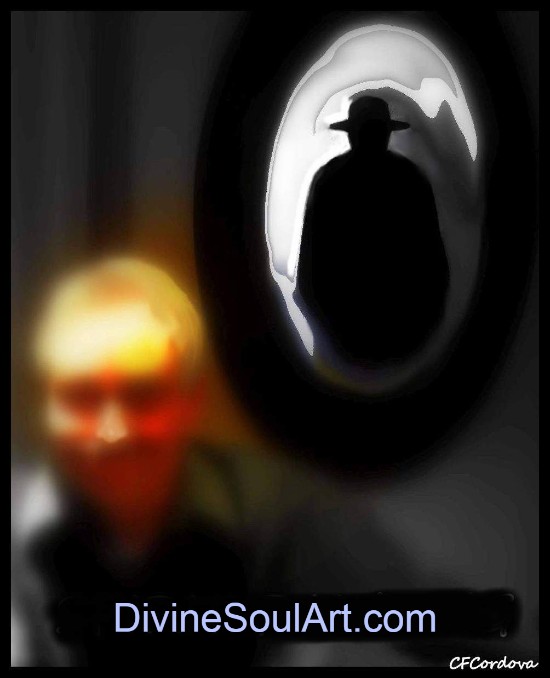
A Shadow Man, also known as Shadow Hat Man or Shadow People, is a type of paranormal entity that many people claim to have encountered.
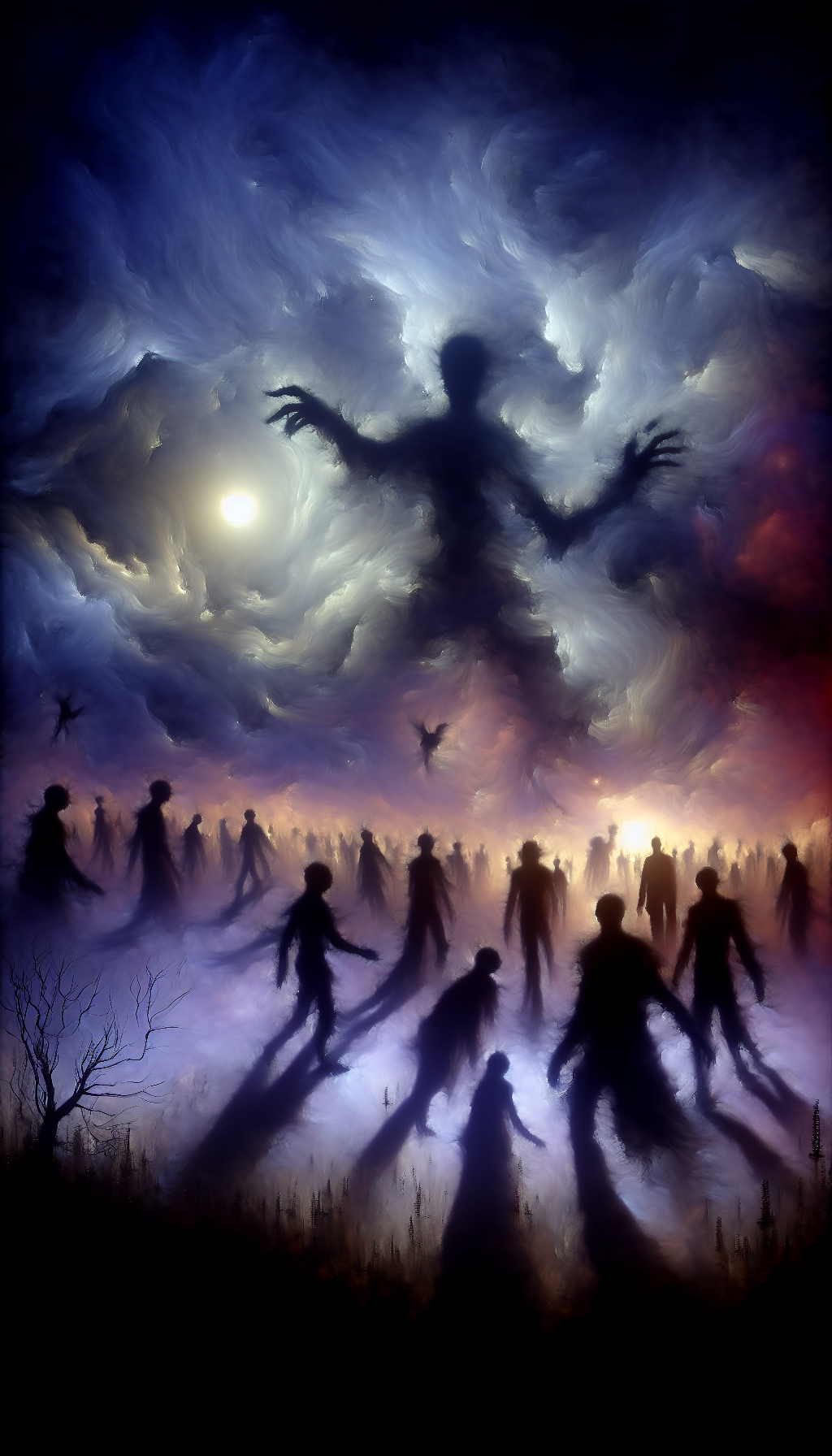
Shadow people are described as tall, thin, dark human-shaped apparitions or silhouettes that often lack clear facial features. People have reported these figures across various cultures and time periods.
Witnesses often describe them as darker than the surrounding darkness, sometimes calling them "a hole in the room" or "a void that shouldn't be there," rather than a solid form.
In many cases, people have reported the entity wearing a black top hat. Unlike ghosts or spirits of the dead, shadow people are believed to be manifestations of a different kind of energy or entity. They are known for their ability to move quickly and quietly, often appearing in the periphery of one's vision.
Encounters with shadow people are frequently accompanied by feelings of fear, anxiety, and dread, making shadow people a particularly unsettling phenomenon.
Encounters are most commonly reported in bedrooms at night, in doorways, in room corners, or while standing over the bed. Many people report seeing shadow figures in corners, accompanied by a strong sense of being watched.
Experiences with shadow people are often associated with feelings of terror or being watched, and the emotional impact can persist long after the figure vanishes.
What Does a Shadow Person Look Like?
A Shadow Person is typically described as dark silhouettes, and their appearance varies enough to keep researchers and paranormal communities debating for years. Here is what witnesses most frequently report:
- Size and shape: The most common form is a human-sized, entirely black silhouette, male in build, with no visible facial features or clothing details. Most are reported at five to seven feet tall.
- Texture and density: Some appear as dense, cut-out shadows with sharp edges, while others flicker, look like smoke, or seem to shimmer like heat distortion. They often appear in peripheral vision and flicker in and out.
- Movement: A Shadow Person can move quickly and disappear into walls. Witnesses describe figures that dart across doorways, peek around corners, or stand motionless before fading.
- Eyes: Some shadow people reportedly have glowing red or yellow eyes. Others have no visible features at all. Occasionally, witnesses report white or pale eyes that seem to glow against the black figure.
- Distinction from ghosts: Witnesses often distinguish shadow people from typical ghosts. A ghost is translucent or glowing; a shadow person is the absence of light, sometimes described as a "hole cut out of the air."
Types of Shadow People
There is no official classification system for shadow people, but online communities and paranormal literature consistently group them into recurring types.
The Generic Shadow Person
A featureless, humanoid shadow, usually silent, standing in doorways or at the bedside. Sometimes it leans over the sleeper during paralysis episodes. It shows no distinct clothing, face, or shape beyond a vaguely human outline. Many reports describe it as simply staring.
The Hat Man
The hat man is a specific type of shadow person wearing what looks like a dark fedora, wide-brimmed hat, or sometimes a long trench coat or cape. Sightings are commonly reported between about 1:00 and 4:00 a.m., with the figure standing in the doorway or at the foot of the bed. Some witnesses describe him tipping his hat before vanishing.
Red-Eyed Shadow People
These shadowy figures appear as dark silhouettes with bright, glowing red eyes. Many report feeling intense dread during encounters with red-eyed entities, as if the figure radiated evil or anger. Some witnesses say the glowing red eyes remain visible for a moment after the body fades into darkness. These accounts are among the most frightening and are sometimes interpreted as evil or demonic by those with religious beliefs.
Yellow or White-Eyed Beings
Similar to red-eyed accounts but with yellow or white, animal-like eyes. In some stories, these other entities are connected with whispered voices, mocking laughter, or a feeling that the being is feeding on fear. These are less commonly reported but carry the same intense emotional impact.
History and Folklore of Shadow Beings
 Shadow people or shadow figures
The concept of shadow people has deep roots in history and folklore, spanning various cultures and time periods. In many ancient societies, shadowy figures were thought to be spirits or demons capable of bringing harm or misfortune. Some cultures believed that these shadow folk were the spirits of ancestors or deceased loved ones trying to communicate with the living.
In modern times, the portrayal of shadow people has been heavily influenced by horror movies and paranormal TV shows, which often depict shadow people as malevolent beings intent on causing terror. This blend of ancient beliefs and contemporary media has shaped the way we perceive and understand shadow people today.
Scientific Research

The Temporal Lobe Seizure Case (Netherlands, 2009)
In a clinical case report published in 2009, researchers found that electrical stimulation of the temporoparietal-occipital junction in a patient with temporal lobe epilepsy produced the vivid illusion of a shadow person standing beside them. The patient experienced gaze deviations and a strong sense of presence. This case is significant because it demonstrates that specific brain regions can generate shadow figure hallucinations directly, supporting neurological rather than purely paranormal phenomena explanations. Neurological disruptions can create sensations of a "felt presence" or shadow beings nearby, and this case is the clearest clinical evidence of that mechanism.
Large-Scale Sleep Paralysis Survey (Cheyne, 2005)
A study of 5,799 current sleep paralysis experiencers examined the frequency and character of hallucinations during episodes. Researchers found that "intruder hallucinations," the sensed presence of a figure in the room, were among the most common experiences. Frequent SP sufferers reported more vivid and detailed apparitions. This data confirms that shadow people may be perceived during sleep paralysis episodes at a remarkably high rate, and that vividness increases with episode frequency.
U.S. Longitudinal Study (Ohayon & Pakpour, 2022)
A longitudinal study of over 12,000 U.S. adults tracked sleep paralysis over three years. About 9.7% reported SP in the prior year at baseline, and persistence was high: nearly 30% of those who initially had SP still experienced it three years later. Risk factors included major depressive disorder, PTSD, pain, and disrupted sleep. Psychoactive substances and sleep deprivation can lead to hallucinations of shadow figures, and this study confirmed that psychiatric history and poor sleep hygiene significantly increase recurrence. While the study did not specifically name shadow people, the hallucinations described- visual figures and sensed presences- match the pattern closely.
Paranormal and Interdimensional Theories

Despite scientific explanations, many experiencers and paranormal phenomena researchers believe shadow people are external supernatural beings, not just hallucinations. Here are the leading theories.
Ghost or Spirit Theory
Some interpret shadow beings as spirits of the dead who lack the energy to appear fully. In this view, they are confused souls, residual hauntings, or guardians tied to a location or person. They are said to linger in doorways and bedrooms because these are transitional, liminal spaces. Other spirits, in traditional belief, can appear more fully formed, while shadow people exist at the weakest end of the manifestation spectrum.
Demonic or Malevolent Entity Interpretation
In certain religious frameworks, shadow people are seen as demons or lower astral entities that feed on fear and target the vulnerable. Some traditions hold that prayer, protective symbols, and cleansing rituals can repel them. The appearance of red eyes or an overwhelming sense of evil during encounters is often cited as evidence of demonic nature.
Interdimensional Beings
Some theories suggest shadow people are interdimensional beings, living entities from a parallel dimension that occasionally intersect with ours. Their flat, dark appearance and ability to vanish into walls are cited as evidence. This idea is often linked online to concepts from quantum physics and multiverse theory, though no formal scientific evidence supports it. Still, the theory resonates with people who feel their encounters were "too real" and too consistent to be merely internal.
Time-Slip and Future Self Theories
A smaller fringe community proposes that shadow people could be humans from the future, astral travelers, or consciousness projections from another timeline. These theories are purely speculative, with no testable predictions or verified evidence. However, they illustrate how deeply the human mind searches for meaning when confronted with the unexplainable.
These theories remain unproven, and no physical evidence confirms the existence of shadow people as external entities. But for many witnesses, paranormal interpretation provides meaning and comfort when the experience feels too vivid to dismiss.
Related Reading
The Hat Man
 shadow spirit- tall man with long coat by Tai
I first heard the term "Hat Man" from a reader who shared a spiritual experience. She mentioned the Hat Man—shadow figures in one of her emails. My initial reaction was, "Who is the Hat Man?" The concept was new to me, and I felt compelled to explore it further.
I wrote to her for further explanation. She was more than happy to oblige. Below are her own words about her experiences with the Shadow person.
“I will be more than happy to tell you about my personal experience with the Hat Man. After reading about people's bad experiences with the Hat Man or shadow people and depicting them as evil spirits, I feel someone should tell people out there that shadow people are not all evil. Moreover, if there is a bad or negative Hat Man out there, where are they getting their negative energy from?
"My entire life, I have had contact with the shadow man. The first time I ever encountered a shadow man entity was in my early teen years. I was sleeping in my sister's bed. She was out, and I thought she was not going to come home that night.
"At some early hour of the morning, I was dreaming that the bedroom door had opened. In the doorway was a black figure wearing a wide-brimmed hat and a long trench coat. There was a bright white light shining behind him.
"He started to walk toward me. It all seemed so real, as if someone was actually in the room. The closer he got, the more scared I became. When he approached me, he put out his arm as if to pull the blankets down. I felt him touch me. I screamed and woke up at the same time.
"My sister, who had returned home, was in front of me and trying to wake me up.
"When I went back to my bed, I said to the shadow person, in a stern and angry tone, ‘If you can hear me, the man with the hat, please don't scare me like that again. It's not very nice.’ For a long time, I had no contact with him.
"Then, I met my husband. Some years later, we had a party at his house. We had a big feed and a bit to drink. When our friends left, we went to bed.
"During the night, I felt someone hit my shoulder. When I opened my eyes, I saw the shadow man. He dashed quickly to the other side of the bed, where my husband was sleeping.
"For some unexplainable reason, I quickly got on my knees on the bed and grabbed my husband's arm, trying to pull him up. Suddenly, he sat up. It was as though someone had pushed him from behind.
"He started throwing up large chunks of food onto the bed. I immediately turned the light on, after seeing what had happened, I realized that he could have choked in his sleep if the shadow man did not tap me on my shoulder waking me up and guiding me on what to do.
"Moreover, I believed that the Hat man had sat him up. There was no way I would have been able to sit him up, especially from the side, and pull one of his arms. I thanked him. The next day, I told my husband what had happened. He didn't remember a thing.
"Years later, the shadow man resurfaced. It was approximately 9.20 pm, and I was waiting for my husband to come home. I was getting ready to turn the kettle on when suddenly, I saw, in my third eye/mind, the shadow man saying to me, “I'll save him.”
"Then, he opened one side of his long coat and swished away. I could also see a vehicle with a bright white light inside, in the distance, about to roll onto the road. When the vehicle stopped, it was upside down. It felt as if l were transported to the street where the accident occurred and then back home.
"When I came to, the thought that it could be my husband came to me. All I could do was wait for him to either come home or call.
"An hour later, he called me from the hospital. He said he was a bit drunk and rolled the yute (vehicle). When I got to the hospital, he seemed fine. He only had a scratch on his back from crawling out of the smashed window.
"The next morning, he told me that all he remembered was a bright white light. Although he knew that the yute was rolling, he didn't feel like he was rolling around. He believed that gravity must have stopped him from being thrown around! Can you believe it!
"The next morning, we went to see the yute. It was completely damaged. A witness told the police that the yute rolled about 5-6 times. Since the yute- a 1950s short 2x door tray-back- was not equipped with seatbelts, my husband was not wearing one. Once again, I thanked the Hat man.”
Update
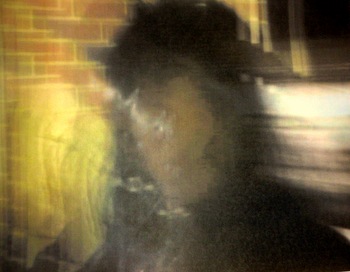 Hat Man's visit
The following is an email I recently received from her.
“I not sure if you remember me, but I wrote to you about the Hatman, and sent you the Spirit Stone picture. I was looking through my photos the other day and came across this picture of me. You can clearly see a man with a hat in front of me. It's a bit blurry because something whooshed himself into the picture. I felt a slight gust of wind, as if someone blew towards me at the time the photo was being taken.
I think it's a picture of a Hatman, and he looks just like the one I quickly saw when my partner was in an accident.”
People Want to Know

What do these beings want? Are they here to harm or guide us?
No one can answer this definitively. Some experiencers feel the shadow person was merely observing, indifferent to them. Others feel an overwhelming sense of evil, as if the entity intended harm. A smaller number of witnesses describe feeling guided or protected, as if the figure was a guardian or warning them of danger, as the woman mentioned above.
From a scientific standpoint, the perceived intention likely reflects the experiencer's emotional state and cultural framework rather than the entity's actual motivation.
In medically documented cases like sleep paralysis, shadow people do not cause physical harm. People may feel pressure on their chest, choking sensations, or the sensation of being touched, but these are part of the paralysis response and fear reaction, not external contact. Bruises or injuries reported after encounters can usually be traced to thrashing in bed or panic responses. Some spiritual traditions view certain shadow beings as capable of harm on an energetic or emotional level, but from a physical safety standpoint, there is no verified evidence of shadow people directly injuring anyone. The experience can feel real enough to leave you scared, but the danger is to your peace of mind, not your body.
Is seeing a shadow person a sign that I have a mental illness?
A single or occasional experience, especially near sleep, is not by itself a sign of mental illness. Meta-analytic research estimates about 30% of people experience sleep paralysis at some point, so these encounters are far more common than most people realize. Concern is warranted if hallucinations happen frequently while you are fully awake, if they involve commands to harm yourself or others, or if they significantly disrupt your daily life. If you are unsure, speak with a healthcare professional. A consultation is a way to gain clarity, not an automatic diagnosis.
Can pets see shadow people too?
Many anecdotal reports describe cats or dogs staring at corners, growling at empty doorways, or avoiding certain spots where owners believe shadow people appear. Animals have more acute senses and may react to subtle sounds, smells, or light shifts that humans miss. This can look to us like they are watching something invisible. There is no scientific way to confirm whether pets perceive the same shadow figures that humans report, so interpretations depend on your own beliefs about the nature of these encounters.
Are shadow people spirits, ghosts, demons, or interdimensional beings?
The answer depends heavily on who you ask. Cultural interpretations of shadow people include beliefs in interdimensional beings, ghosts, and spirits. In religious traditions, some view these entities as demons or malevolent forces that feed on negative energy. Others consider them lost spirits of the dead, too weak to appear fully. Some modern paranormal researchers classify them as beings from parallel dimensions.
The key distinction: ghosts in traditional belief tend to have identifiable facial features, clothing, and personality. Angels are luminous and benevolent. Demons share the threatening nature of shadow beings but are rooted in specific religious frameworks. Unlike ghosts or angels, shadow people are consistently described as featureless, opaque, and ambiguous in intention. Interdimensional beings, by contrast, are theorized to exist outside our reality entirely, only briefly overlapping with our dimension.
How far back does the belief in shadow people go?
Accounts of shadowy figures and night watchers stretch back centuries. Many cultures have similar figures to shadow people, such as the "Old Hag" in English folklore, who sits on the chest of sleeping victims. Islamic Djinn are compared to shadow people for their supernatural characteristics, sometimes appearing as dark, smoke-like forms. The Choctaw people have the Nalusa Falaya, or "Long Black Shadow," a being that stalks the young. Guy de Maupassant's 1887 story "Le Horla" describes an invisible, demonic presence eerily similar to modern accounts of shadow people. While the specific label "shadow people" is modern, the experience is ancient and global.
When to Seek Help
The emotional weight of seeing shadow people should not be underestimated. Common reactions include a racing heart, sweating, intense fear, lingering anxiety about sleep, and a deep-seated fear of the dark or of being alone at night. Many people become afraid to close their eyes. Shadow people often attack during sleep or deep relaxation states, making the bedroom itself feel unsafe.
A single, brief episode, especially around sleep, can be a normal, though frightening, experience. Many people have one or two such encounters in their lives, particularly during periods of high stress, sleep deprivation, or young adulthood.
Signs that professional help may be needed:
- Episodes happening several times a week
- Inability to sleep from fear
- Daytime hallucinations while fully awake and alive to surroundings
- Hearing commanding voices or other auditory hallucinations
- Distress that interferes with work, school, or relationships
- Substance use contributing to the experiences
If you have noticed these patterns, talk with a medical doctor or mental health professional. They can rule out sleep disorders like narcolepsy, medication side effects, or psychiatric conditions. The most common explanation for shadow person sightings is sleep paralysis, and treatments exist that can dramatically reduce episodes.
Seeking help does not invalidate spiritual or paranormal beliefs. A doctor can address the physical and psychological aspects of the experience, while you maintain whatever interpretive framework gives you peace. Both can coexist.
How to Cope With Shadow People Encounters
Improve Your Sleep Routine
- Avoid heavy meals, caffeine, and stimulants late at night
- Sleep on your side rather than your back (sleeping supine increases SP risk)
- Create a predictable wind-down routine to signal your body it's time for rest
Optimize Your Bedroom
- Use a dim night light to reduce the sharp contrasts that create dark shadows and ambiguous shapes
- Keep clutter off chairs and doors so objects don't resemble a standing figure
- Close closet doors and minimize open sightlines to mirrors and doorways
- Remove or cover items that cast unusual shadows on walls
In-the-Moment Coping
If you wake paralyzed with a black figure in the room, try these:
- Focus on wiggling a single finger or toe to break the paralysis
- Remind yourself: "This is sleep paralysis. It will pass in seconds."
- Control your breathing, slow inhales and exhales, rather than fighting the figure
- Avoid trying to speak or scream, which can increase panic
Grounding and Anxiety Reduction
- Practice deep breathing or progressive muscle relaxation before bed
- Journal after episodes to track patterns (time, body position, stress level, what you ate)
- Consider cognitive behavioral therapy (CBT) to break the cycle of fear and anticipation
- Mindfulness meditation can lower baseline anxiety and reduce threat perception at night
Spiritual and Cultural Practices
For those with spiritual beliefs, protective practices can reduce fear and promote a sense of security, even if the mechanism is psychological:
- Chanting protective mantras can help against shadow people, according to several spiritual traditions
- Lighting juniper incense can clear negative energy from spaces
- Daily prayers to protective deities can provide spiritual defense
- Dorje Shugden is a deity known for spirit disturbance protection in Tibetan Buddhist practice
- Religious symbols, candles, and cleansing herbs (such as sage) are widely used by experiencers to protect their sleeping space
The goal of any coping strategy is the same: reduce the fear, reclaim your room, and restore your sense of safety. Whether you approach this through science, spirituality, or both, what matters is that you feel secure enough to sleep.
Summary
Often, when certain phenomena occur, the scientific community tends to categorize them as mental health issues. While some cases may indeed be associated with mental health problems, I believe that not all instances should be classified this way, as in the case of the woman mentioned earlier.
People who do not believe in these encounters often attribute sightings of shadow folk to sleep paralysis. Sleep paralysis is a sleep disorder that occurs when an individual falls asleep or wakes up and cannot move. During these episodes, people may experience terrifying sensations and visions, including the perception of a dark shadow entity. Another explanation is sleep deprivation, which can lead to hallucinations, increasing the likelihood of seeing shadow people after extended periods without rest.
Since the woman from the emails did not experience any sleep paralysis or sleep deprivation as mentioned above, I wonder what the scientific community would say about her.
Belief in shadow people is a personal choice. Nonetheless, some life events remain beyond scientific explanation.
Click below and views more than 600 pieces of spiritual artwork

Spiritual Books
If you enjoy the articles on this website, you will also appreciate the short stories in the books below. Click here and continue the journey.