Am I an Empath or Just Sensitive?
 Am I an empath? True empath -feeling other individual's energy By Tai
What Is an Empath?
In order to answer the question, am I an empath, you first need to understand what an empath is.
The word empath refers to someone who doesn't just notice or understand other people's feelings—they actually feel other people's emotions deeply, sometimes experiencing their pain, joy, or anxiety as if it were happening to them. This goes beyond the normal human ability to empathize. While most people can recognize when a friend is sad and offer comfort, an empath may physically feel that sadness settle into their chest, affecting their mood for hours or even days.
The difference between regular empathy and being an empath is significant.
1-Cognitive empathy means you understand someone's perspective intellectually.
2-Affective empathy means you feel concern for them emotionally.
3-Empaths tend to absorb and internalize what others are experiencing—their nervous system responds as if the emotion originated within them. In other words, they tend to pick up other people's energy.
Here's a concrete example: You walk into a meeting room where everyone seems calm and professional. Yet you feel your heart racing and a knot forming in your stomach. Later, you find out a coworker was silently panicking about a deadline. You picked up on what they were hiding without any verbal cues or body language to explain it.
In cultural and spiritual contexts, empaths are sometimes called old souls, intuitive coaches, or people with a gift for reading people. These labels acknowledge a real aspect of the experience. However, as of 2025, empath is not an official clinical diagnosis in diagnostic manuals such as the DSM-5. Being an empath is not a mental health disorder. It's a descriptive term for a way some people deeply experience the feelings, emotions, energies, and even physical feelings of others as if they were their own
Quick Self-Check: Am I an Empath?
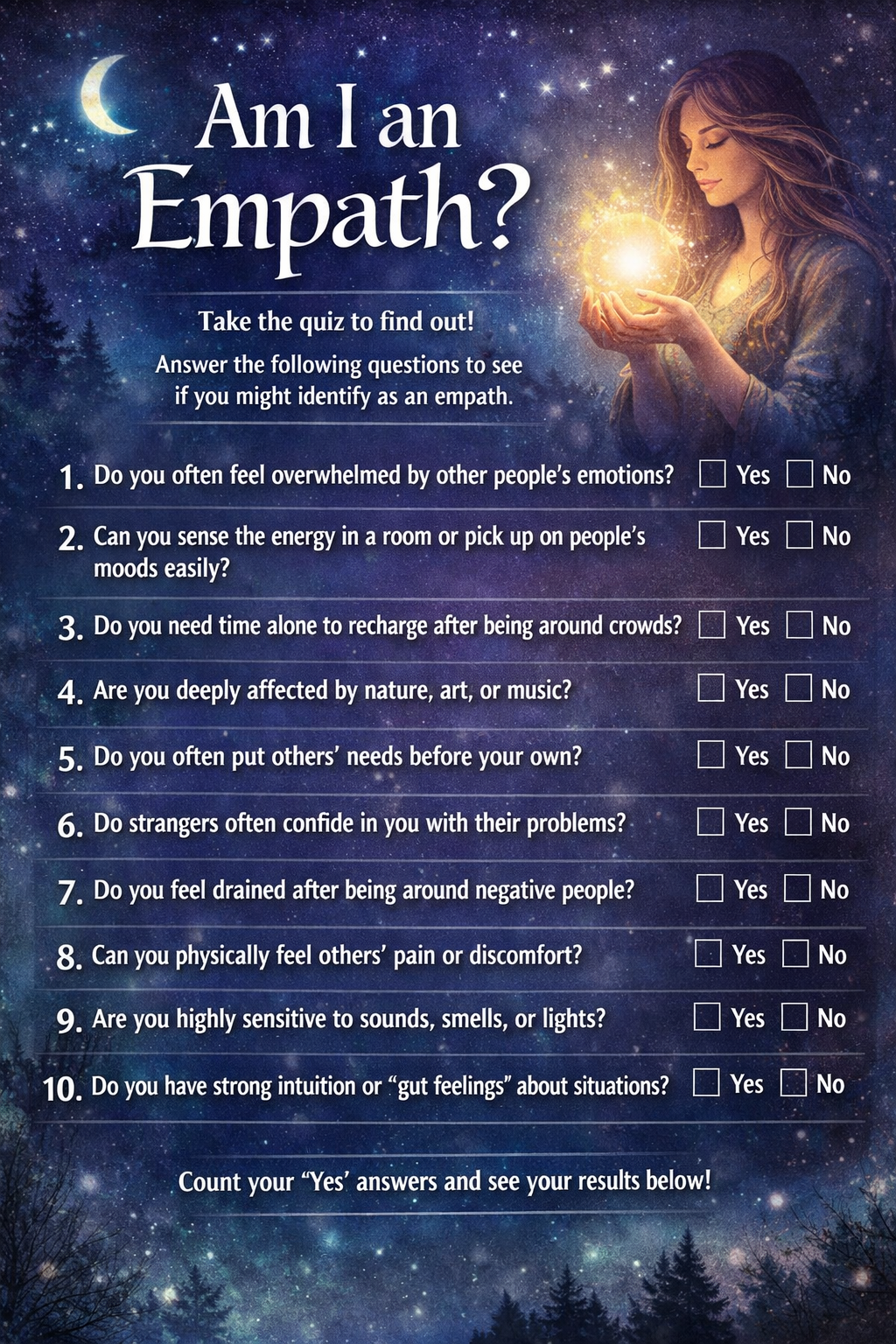 Can you feel emotions of other people? If so, perhaps you are a true empath
Before diving deeper into the nuances of empath traits, here's a quick, informal self-reflection list. If many of these statements sound familiar, the rest of this article will likely resonate with you.
Consider how strongly you agree with each statement:
- I often feel drained after being in crowds or busy public places
- I frequently take on other people's moods without meaning to—if they're anxious, I become anxious
- Violent news stories or movies affect me more deeply than they seem to affect most people I know
- I need significant alone time to emotionally decompress after social events
- Strangers often tell me their life story or confide in me without much prompting
- I can sense tension in a room the moment I walk in, even before anyone speaks
- I sometimes struggle to tell the difference between my own emotions and the feelings I've absorbed from someone else
- I'm drawn to helping professions or causes, sometimes to the point of exhaustion
- I feel physical sensations in my body that seem connected to other people's pain or discomfort
- I have a strong intuition about people that often proves accurate
How to interpret this: If you strongly agreed with five or more statements, you likely have significant empath or highly sensitive traits. The more statements that resonated, the more likely you are to identify with the empath experience.
This is not a scientific empath test or diagnosis. It's a tool for self-awareness and a starting point for a deeper understanding of your own patterns.
Empath vs. Highly Sensitive Person
One of the most common questions people ask is, “Am I an empath or just sensitive?” The terms overlap significantly, and many people use them interchangeably—but they're not identical.
Highly Sensitive People (HSPs) are individuals with sensory processing sensitivity, a trait researched extensively by psychologist Dr. Elaine Aron. HSPs feel things deeply and are easily overwhelmed by bright lights, loud noises, crowds, and emotional tension. They notice subtle cues that the average individual might miss. However, HSPs primarily react to emotions and stimuli rather than absorbing them into their own experience.
Empaths, on the other hand, tend to absorb and carry the emotions of others in their own bodies. An empath may leave a conversation feeling depressed and not realize until hours later that the depression belongs to the person they were talking to, not themselves. This absorption creates genuine confusion about what is theirs versus what belongs to someone else.
Emotional response:
Highly Sensitive Person -Reacts strongly to emotions
Empath- Absorbs emotions as their own
Physical sensation:
Highly Sensitive Person- Overwhelmed by sensory input.
Empath- May feel others’physical pain
After exposure:
Highly Sensitive Person- Needs rest from overstimulation.
Empath- Needs to cleanse absorbed feelings.
Boundary Clarity:
Highly Sensitive Person- Knows feelings are reactions to others.
Empath- Often confused about whose feelings are whose
Example: A highly sensitive person may cry during a sad movie and need quiet time afterward to recover from the intensity. An empath may think about the characters’ suffering for days, reliving their pain as if it were a personal experience, and feel genuine grief even though the events were fictional.
Research suggests around 15–20% of people are HSPs, but the subset who identify as empaths is smaller and less clearly defined in scientific literature. Numerous empaths are also highly sensitive people, but not all highly sensitive people experience the absorption quality that defines the empath experience.
What Makes Someone an Empath?
Science hasn't fully explained why some people absorb the emotions of others, while others don't. However, several theories from research and clinical practice offer possible explanations.
Mirror Neurons and Brain Wiring
Mirror neurons are brain cells that fire both when we perform an action and when we observe someone else performing that action. They help us understand and resonate with others' experiences. Some researchers hypothesize that empaths may have more active mirror neurons or a more responsive mirror neuron system than typical. This remains under study, but it offers one biological explanation for why empaths seem to experience what others feel rather than just observe it.
Genetics and Temperament
Sensitivity often runs in families. Several empaths report that one or both parents were also highly sensitive or had powerful intuition about other people's moods. If you grew up watching a parent who could sense when something was wrong before anyone spoke, you may have inherited similar traits.
Early Life Experiences
Growing up in unpredictable, emotionally intense, or traumatic environments can sharpen attention to others' moods as a survival skill. Children in households with conflict, addiction, or emotional instability often learn to read the room constantly—sensing a parent's anger before it explodes or detecting shifts in atmosphere that signal danger. This hypervigilance can develop into empath traits that persist into adulthood.
Nature and Nurture Combined
Being an empath is likely a result of a combination of innate sensitivity, brain wiring, and life experiences. This is not something you choose through willpower, nor can you simply decide to stop being this way.
Gaining insight into the origins of these empathic traits can be beneficial in alleviating feelings of self-blame. Instead, it encourages a shift in focus toward developing effective strategies for managing these abilities, allowing you to navigate the world with greater ease and understanding.
Types of Empaths
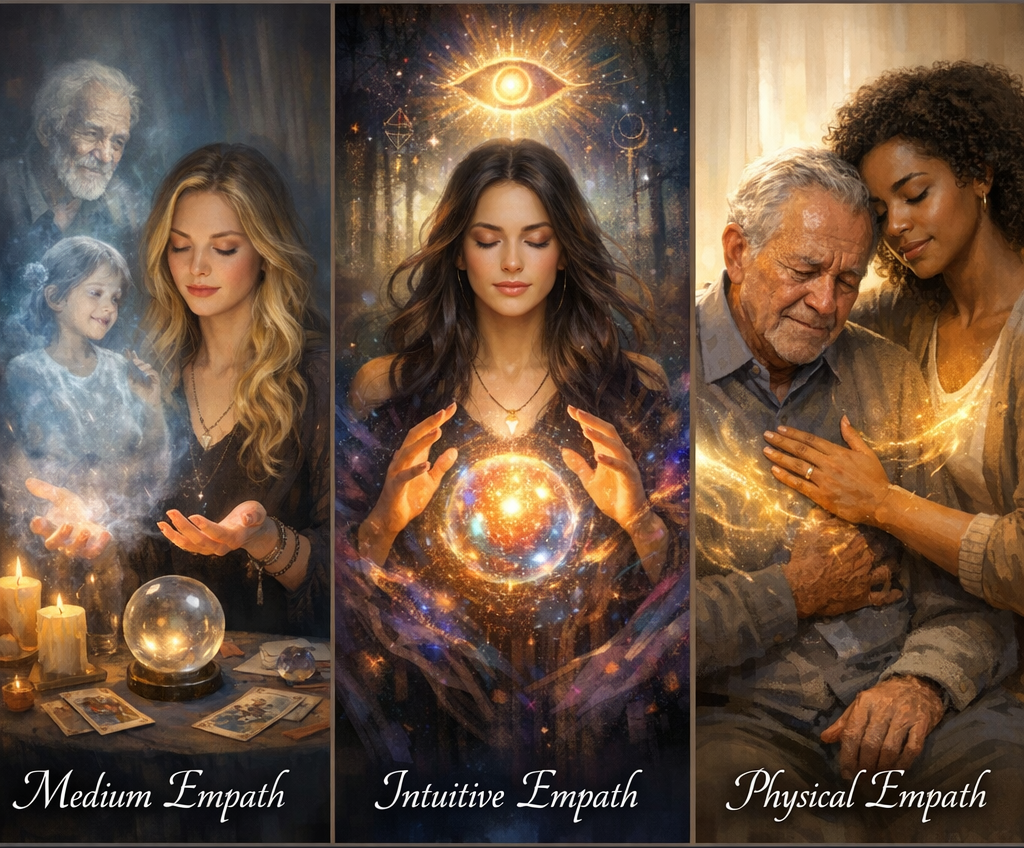 Empath feels 1- people's energy 2- other's pain 3- other's feelings
These “types” are informal categories people use to understand their experience. They aren't rigid boxes from a diagnostic manual—they're tools for self-understanding. Empaths resonate with more than one type.
Medium Empath
A medium empath is someone who possesses a high level of sensitivity, allowing them to deeply feel others' emotions and feelings (empath) while also sensing or communicating with spirits (medium). This unique combination enables them to bridge the emotional world and the spiritual realm, fostering profound connections.
Example: A friend of mine, a medium empath, once shared that although he could pick up others' emotions, he was also sensitive to the current state of certain spirits. He recalled an instance when he was feeling fine, but suddenly he was overwhelmed by feelings of depression and despair. He recognized that these emotions were not his own. Later, he discovered that they were coming from a spirit who had recently committed suicide and was experiencing confusion. The last thing the spirit remembered was putting a gun to his head and pulling the trigger. Although he desperately wanted to go back to his family, he couldn't. Since that moment, everything for him had been darkness, confusion, and despair once again.
The medium stated that although he could feel emotions of others, whether in the flesh or spirit, the process can be quite intense at times.
Emotional Empath
The emotional empath is the most common type. These empaths absorb people's feelings directly into their own experience. When someone near them is anxious, they feel anxiety. When a friend experiences joy, they light up with genuine happiness. The challenge is that negative emotions are absorbed just as readily as positive ones, often leaving emotional empaths drained after exposure to someone in distress.
Example: Your coworker mentions she's stressed and anxious about a job project she must complete, and within minutes, you're stressed and anxious too—even though the project has nothing to do with you.
Physical Empath
Physical empaths experience other people's pain and physical symptoms in their own bodies. They may develop headaches, nausea, or fatigue that mirrors what someone nearby is experiencing. This can be particularly confusing when the physical feelings have no apparent reason connected to their own health.
Example: You sit next to a colleague with chronic back pain, and by the end of the meeting, your own back is aching despite being fine when you arrived.
Intuitive Empath
Intuitive empaths have strong gut feelings about people and situations. Their ability to pick up on subtle verbal and nonverbal cues is so refined that their insights often appear almost psychic. They sense dishonesty, hidden agendas, or unspoken needs without logical evidence to support their conclusions.
Example: You meet your friend's new partner and immediately feel something is off, even though they seem charming. Months later, your intuition is validated when concerning behavior surfaces.
Environmental or Animal Empath
Some empaths are deeply affected by the energy of places, nature, and animals. They may feel uncomfortable in locations with difficult histories, experience calm in forests or near water, or have unusually strong bonds with animals. Spending time in nature often feels more restorative than spending time with people.
Example: Walking into an old hospital or building where suffering occurred can make you feel suddenly heavy and sad, while spending time in a garden or park can restore your sense of wellness.
Not identifying with every type doesn't disqualify you from being an empath. These experiences exist on a spectrum, and your particular pattern is unique to you.
Common Signs You Might Be an Empath
This section expands beyond the quick self-check to provide a more comprehensive look at empath signs. You don't need to relate to every single one—empaths tend to share many of these characteristics, but the specific combination varies.
Absorbing Others’Moods Without Trying
You don't just notice when people around you are upset or excited—you actually feel those same things in your own body. After spending time with an angry person, you feel irritable. Being around someone joyful makes you feel uplifted. This happens automatically, without conscious effort.
Feeling Overwhelmed in Crowds
Shopping malls, concerts, busy airports, and parties can feel like walking through an emotional minefield. You're not just dealing with noise and visual stimulation—you're processing the feelings of dozens or hundreds of people simultaneously.
Needing Significant Alone Time
After social events, even enjoyable ones, you require time to recover. This isn't introversion alone—it's the need to shed emotions you've picked up from others and return to baseline.
Being Deeply Affected by News and Media
Stories of suffering in the news don't just inform you—they haunt you. You may avoid violent movies, true crime content, or coverage of disasters because the emotional impact lingers far longer than seems reasonable.
Example: Sometimes, you watch a tragic news report on TV that unknowingly affects you so deeply that you find yourself crying uncontrollably.
Strangers Confiding in You
People you barely know share their problems, life stories, and deepest concerns with you. You seem to signal safety and understanding without doing anything specific to invite disclosure. Many empaths become unintentional therapists in their social circles.
Sensing Lies and Hidden Tension
You pick up on when people's words don't match their true feelings. Something about their energy feels off, even when their body language and statements seem normal. This ability can make you uncomfortable in environments where deception or suppressed conflict is common.
Physical Discomfort Around Conflict
Arguments, even ones you're not involved in, create physical feelings—tightness in your chest, nausea, headaches, or exhaustion. You may go to great lengths to avoid or resolve conflict because of the energetic cost it entails.
Difficulty Distinguishing Your Feelings From Others
This is perhaps the most confusing sign. You may feel suddenly sad, anxious, or angry for no apparent reason, only to realize later that you were around someone experiencing those exact emotions. The line between your feelings and theirs blurs easily.
Sensing Room Energy Instantly
You walk into a space and immediately know something is wrong—or right. Old buildings, hospitals, or places where intense events occurred may feel heavy or unsettling. Peaceful environments feel noticeably different in your body.
Caring Very Much to the Point of Personal Cost
You don't just care about loved ones—you care about strangers, animals, and causes with an intensity that can become exhausting. Caring very much is both your gift and your potential downfall.
Important note: Some of these signs can also appear in conditions like anxiety, depression, PTSD, or autism spectrum conditions. If these traits cause significant distress or impairment in your daily life, professional support can help you understand what's happening and develop appropriate strategies.
Pros and Cons
Many people search “am I an empath?” because they feel overwhelmed or confused by their experiences. But empathy sensitivity isn't purely a burden—it also comes with genuine strengths that can enrich your life and those around you.
Benefits of Being an Empath
Deep intuition: You often sense the right path before you can explain why logically.
Exceptional listening: You're naturally a great listener, which draws people to confide in you.
Strong compassion: You genuinely understand suffering, making you a caring, deeply supportive presence.
Meaningful relationships: Your one-on-one connections tend to be unusually deep and authentic.
Reading situations: You pick up on subtle cues others miss, helping you navigate complex social dynamics.
Ability to understand others: You can put yourself in someone else's shoes in ways that create a real connection.
Challenges of Being an Empath
Emotional exhaustion: Constantly processing others' emotions leads to burnout.
Compassion fatigue: Too much empathy for too many people depletes your resources.
Attracting emotional vampires: People who drain energy are drawn to your willingness to listen.
Difficulty saying no: Your awareness of others' needs makes declining requests feel cruel.
Blurred boundaries: You lose track of your own needs while focusing on everyone else's.
Feeling overwhelmed regularly: Excessive stimulation from emotional input becomes the norm.
Real-world scenario:
Consider an empath working as a nurse. They're drawn to the profession because caring for suffering patients feels meaningful. They're excellent at reading patients’ unspoken needs and providing comfort. But they also carry patients' pain home at night, struggle to leave work stress behind, and eventually face burnout because they can't stop absorbing what they're exposed to.
The key insight is this: learning healthy boundaries and emotional regulation skills can shift empath traits from feeling like a curse to functioning more as a genuine strength.
How to Avoid
Burning Out or Developing Mental Health Issues
Here's the good news: you cannot and do not need to stop being an empath. Your sensitivity is part of who you are as a human being. But you can drastically reduce overwhelm and exhaustion with practical life strategies that protect your energy while still allowing you to be present for others.
Avoid Energy Vampires
Energy vampires are individuals who drain emotional energy from others, often leaving their targets feeling fatigued or overwhelmed. Common signs of encountering an energy vampire include feeling consistently drained after spending time with someone or sensing an unusual heaviness in their presence. Some compare it to a kind of inner emptiness or a car without any gas.
Cleansing the energy field is essential for empaths to let go of negative energies absorbed from others, and at the same time, refill their inner tanks. Practicing self-wellness activities, such as setting boundaries and grounding exercises, can safeguard emotional energy and prevent feeling drained
Clear Boundary Strategies
- Say no without lengthy justification. “I can't do that right now” is a complete sentence. You don't owe anyone an explanation for protecting your energy.
- Limit time with draining people. Some relationships cost more than they give. Smaller group settings or time-limited interactions can help you handle crowds and difficult personalities.
- Choose when to listen. You don't have to be available 24/7 for everyone's problems. Setting specific times when you're open to deep conversations—and times when you're not—protects your well-being.
Self-Care Practices
- Daily alone time is non-negotiable. Even 20 minutes of solitude can help you process and release what you've absorbed.
- Spending time in nature helps many empaths reset their nervous system. Water, trees, and open spaces offer relief from the intensity of human emotions.
- Journaling to sort emotions can clarify which feelings are yours and which may have been absorbed from others. Write about what you felt during the day and where those feelings might have originated.
- Sensory breaks, such as baths, quiet rooms, or walks without headphones, give your system a break from constant input.
Grounding Techniques
When you notice you're absorbing too much, these techniques can bring you back into your own body:
- Deep breathing: Inhale for four counts, hold for four, exhale for four
- Feet on the floor: Focus intensely on the physical sensation of your feet touching the ground
- Five senses grounding: Name five things you can see, four you can hear, three you can touch, two you can smell, one you can taste
- Hand on chest: Place your palm over your heart and breathe slowly, reminding yourself, “I am here, in my body, in my experience.”
Therapeutic Support
Working with a mental health professional, such as a counselor familiar with high sensitivity, trauma, or codependency, can be transformative. A good mental health therapist won't try to eliminate your sensitivity—they'll help you build tools to manage it so it works for you rather than against you.
Also, working with a spiritual mentor in cases of psychic and medium empath can be extremely helpful.
Empath's Survival Guide
Healthy Boundaries
An empath survival guide is essential for navigating daily life. One crucial aspect of this guide is setting boundaries. Boundaries can be particularly challenging for empaths since they often feel the emotional impact of their "no" on others. Despite this difficulty, saying "no" is sometimes necessary and requires conscious effort. It's important to remember that boundaries are not optional luxuries; they are vital for your well-being and survival.
Emotional Boundaries
- You are not responsible for fixing everyone's feelings. You can acknowledge pain without taking on the job of eliminating it.
- Recognize that you can care without rescuing. Caring deeply doesn't require you to solve problems that aren't yours to solve.
- Allow others to be uncomfortable. Not every negative emotion requires your intervention. Sometimes people need to sit with their own feelings without you rushing to soothe them.
Physical and Time Boundaries
Limit late-night emotional phone calls. Your own good sleep matters. Emergencies are one thing; chronic crisis calls are another.
• Step away from draining conversations. Excuse yourself to use the bathroom, get water, or simply say you need a moment.
• Schedule downtime after social events. Don't book back-to-back social obligations. You need recovery time, and pretending you don't leads to burnout.
Boundary Phrases You Can Actually Use
Someone wants to vent when you're depleted:
What you can say-“I care about you, but I am not in an emotional space to talk about this right now", or "I am not feeling well right now."
A conversation is draining you:
What you can say-“I need to take a break and check in with myself," or "Excuse me, I need to make a phone call.
Someone expects you to solve their problem:
What you can say-“I can listen, but I'm not able to fix this for you.”
You need to leave an overwhelming environment:
What you can say-“I'm going to step outside for some air," or "I need to go right now. Take care."
Boundaries are not selfish. They're necessary for empaths to stay healthy enough to show up for the people and causes they genuinely care about. You can't pour from an empty cup, and you can't absorb indefinitely without consequences.
How Empaths Can Use Their Traits as a Strength
When combined with self-awareness, good boundaries, and appropriate skills, empath traits can become genuine superpowers rather than burdens.
Environments Where Empaths Thrive
Empaths often excel in roles that leverage their natural ability to understand and connect:
- Counseling and therapy: Your ability to truly feel what clients experience makes you exceptionally effective
- Coaching and mentoring: Intuitive empaths often sense what someone needs to hear before they know themselves
- Nursing and healthcare: Physical empaths can pick up on symptoms and distress that others miss
- Teaching: Understanding students' emotional states helps you meet them where they are
- Creative fields: Writing, art, and music allow you to channel absorbed emotions into meaningful expression
- Animal care: Environmental empaths often connect with animals in ways that feel more manageable than human interaction
- Social justice work: Your deep sense of others’ suffering fuels meaningful advocacy
Developing Your Gifts
- Trust your strong intuition. Notice when your gut feelings have been right in the past. Learn to honor that inner guidance while still checking facts and logic.
- Learn to name your own emotions precisely, track triggers, and understand your patterns. This clarity helps you distinguish your feelings from absorbed ones.
- Find your people. Build communities with other sensitive people through support groups, online communities, or local circles. Many empaths feel validated and less alone when they connect with others who share their experience. A specialized group of sensitive souls can provide understanding that the average person simply can't offer
When to Seek Professional Support
Being an empath is not a problem in itself. But when sensitivity leads to chronic overload, anxiety, depression, or other disorders affecting your daily functioning, extra support becomes essential.
Signs It's Time to See a Therapist or Mentor
- Constant exhaustion that doesn't improve with rest
- Panic or severe anxiety in social situations
- Inability to distinguish your emotions from others' emotions consistently
- Difficulty functioning at work, school, or in relationships
- Using substances or unhealthy behaviors to cope with emotional overload
- Feeling like you're losing yourself or can't find your own identity
What to Look for in a Professional
A good mental health therapist won't try to erase your sensitivity. Instead, they can help you build skills so your empath traits become more manageable and less painful. Look for professionals who mention experience with:
- High sensitivity or sensory processing sensitivity
- Trauma and PTSD
- Codependency
- Burnout and compassion fatigue
- Anxiety in private practice or clinical settings
Asking for support is not a weakness—it's an act of care for your own nervous system and long-term health. Your ability to help others depends on your own stability. Getting help ensures you can continue being the compassionate, caring person you are without destroying yourself in the process.
Spiritual Mentor
A spiritual mentor serves as a compassionate guide for individuals, particularly empaths, who often navigate intense emotional sensitivities. This mentorship involves helping these individuals understand and manage their heightened sensitivity, enabling them to establish healthy boundaries that protect their emotional well-being. Moreover, a spiritual mentor assists in the healing of past trauma and emotional wounds, facilitating a journey toward self-discovery and empowerment. Through this transformative process, empaths can learn to reinterpret their sensitivity from a perceived burden into a profound spiritual gift. This shift not only fosters personal growth but also equips them to leverage their unique abilities to support and uplift others on their own journeys. (Google)
SUMMARY
 Feeling one's own emotions as well as else's emotions and feelings.
Empaths feel their own emotions as well as other people's emotions and feelings. Since they can sense others' pain, self-care is especially important for maintaining a balanced state of mind.
However, understanding your empath traits is the first step toward thriving rather than just surviving. While you may not have had a choice in experiencing other people's emotions so intensely, you absolutely have the power to shape how you engage with this aspect of yourself.
Start by establishing a clear boundary—perhaps identifying a specific situation that overwhelms you and determining how you can limit your exposure to it.
Next, incorporate a grounding technique that resonates with you, such as deep breathing, meditation, or connecting with nature.
Finally, consider having an open and honest conversation about your emotional needs with someone you trust. Small changes compound over time into a life where sensitivity becomes your strength rather than your struggle.
Remember, to stay grounded to avoid any mental health issues.
Long story short: cleanse, protect, stay pure-hearted and grounded.
Related Link
Click below and view more than 600 pieces of spiritual artwork

Spiritual Books
If you enjoy the articles on this website, you will also appreciate the short stories in the books below. Click here and continue the journey.