Quan Yin Goddess
Mother of Mercy
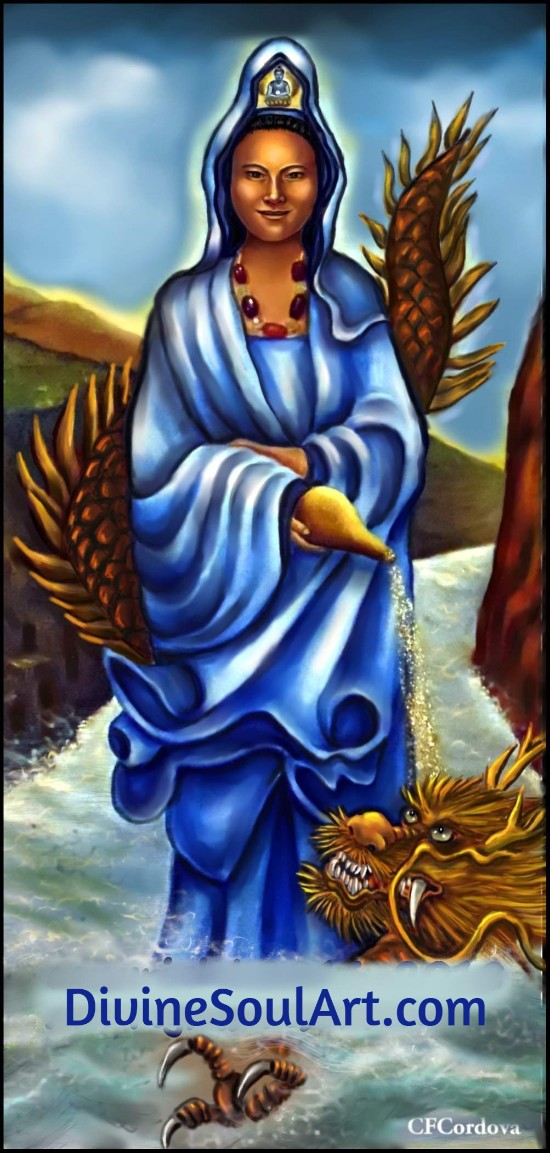 Quan Yin Goddess and Mighty Dragon King
Who is Quan Yin, the Goddess of Mercy?
Who is Quan Yin Goddess?
Walk into almost any Buddhist temple in East Asia, and you'll likely encounter her: a serene female figure in flowing white robes, eyes half-closed in meditation, radiating an almost tangible sense of peace. This is Quan Yin, the bodhisattva of compassion, beloved across China, Japan, Korea, and Vietnam as the ultimate embodiment of unconditional love and great mercy.
Guan Yin is often compared to the Virgin Mary because of their compassionate and loving mother figure.
Quan Yin is the Chinese manifestation of Avalokiteshvara, an Indian bodhisattva first described in Buddhist texts and introduced to China around the 1st century CE, as Buddhism spread via the Silk Road. The name itself carries profound meaning—she is the one who perceives the world's sounds, who hears every cry of suffering and responds with wisdom and protection.
You'll encounter several spellings of her name:
Quan Yin, Guan Yin, Kwan Yin, Kuan Yin, Guanyin
By the Song dynasty (960–1279 CE), she had transformed in popular imagination from the originally depicted male form into a female or androgynous mother goddess figure. The Ming Dynasty (1368–1644 AD) solidified her image as China's most popular female deity—loved rather than feared, modeled as the ideal of Chinese beauty.
Today, you'll find her statues at entrance halls of homes, family altars, seacoast temples protecting fishermen, hospital chapels offering comfort, and even vegetarian restaurants as a symbol of compassion for all sentient beings.
Etymology and Names of Quan Yin
The name “Quan Yin” (Guānyīn in Mandarin) represents the Chinese translation of the Sanskrit name Avalokiteshvara, though the meaning shifted slightly through cultural transmission.
Breaking down the meaning of Guan Yin:
- Guān: To observe or to perceive.
- Yīn: Sounds or voices.
Together, her name means “She who hears the cries (sounds) of the world”—a powerful reminder of her core function as the Buddha Dharma's living expression of compassion.
An alternate Chinese name, Guānzìzài -“Lord of Contemplation", emphasizes her meditative, all-seeing nature. This version connects more directly to the original Sanskrit meaning of Avalokiteshvara, which translates roughly to “the lord who looks down” upon the suffering of the earth.
Across Asia, she carries different names while maintaining her essential identity:
- Kannon or Kwannon (Japan)
- Gwan-eum (Korea)
- Quan Âm or Quan Am (Vietnam)
- Phra Mae Kuan Im (Thailand)
- Chenrezig (Tibet)
- Padmapāṇi (Sanskrit, meaning “lotus holder”)
Each name reflects local linguistic traditions while honoring the same compassionate bodhisattva who vowed to delay personal enlightenment until all beings are freed from suffering.
Historical Origins and Evolution
Understanding Quan Yin requires tracing a remarkable journey across centuries and continents—from ancient India through the mountain passes of Central Asia into the heart of Chinese civilization.
From India to China
The figure we know as Quan Yin originated in early Indian Buddhism during the first millennium BCE-CE as Avalokiteshvara. This male bodhisattva arrived in China via the Silk Road around the 1st–2nd centuries CE, carried by merchants, monks, and pilgrims.
In Indian iconography and early Chinese art (4th–7th centuries), Avalokiteshvara appeared decidedly masculine—a princely figure often shown with a small moustache, wearing royal ornaments, embodying the philosophical depth of Buddhist teachings.
The Transformation
Between the Tang dynasty (618–907 CE) and Song dynasty (960–1279 CE), something remarkable happened. Popular devotion gradually reshaped this male figure into a merciful, motherly, female manifestation.
Several factors drove this transformation:
- Cultural preference: Chinese society valued purity symbols, making a white-robed female figure more accessible to common people
- Scriptural flexibility: The Lotus Sutra describes the universal gateway through which Avalokiteshvara manifests in thirty-three manifestations, including female forms
- Regional needs: Coastal and agrarian communities needed a protector who felt approachable—a mother figure rather than a distant philosopher
- Artistic evolution: The Shuiyue (Water-Moon) Guanyin from mid-10th-century Dunhuang paintings established the iconic white-robed female image
By the 12th century, during the Song era, female depictions dominated Chinese Buddhist art. The rise of Mount Putuo (Putuoshan) off Zhejiang Province as her sacred island during the Tang–Song period cemented her identity as a distinctly Chinese goddess.
Quan Yin's Symbols and Iconography
Quan Yin's appearance varies across regions and centuries, but certain elements remain constant—each symbolizing an aspect of her boundless compassion and supernatural power.
The White-Robed Form
The most recognized image shows the classic “White-Robed Quan Yin” (Báiyī Guānyīn):
- Seated or standing in flowing white robes symbolizing purity
- Barefoot, denoting transcendence over worldly attachments
- Peaceful, downcast eyes suggesting meditation and humility
- Often positioned beside a lotus pond, waterfall, or the southern sea
This Yulan Guanyin form, developed during the Tang dynasty, represents the ideal of Chinese beauty—approachable, gentle, and utterly without pretension.
Sacred Guan Yin Symbols and Their Meanings
According to Google, "Guan Yin (Avalokitesvara) Buddhist symbols emphasize compassion, purity, and relief from suffering."
A Water Vase: Contains pure water, or “nectar of life” (amṛta), which soothes suffering and blesses homes; it is associated with the eight Buddhist symbols.
Willow branch: Flexible yet unbreakable; used to sprinkle sacred water for healing and purification
The willow branch deserves special attention. In Chinese medicine, willow has healing properties, and when Quan Yin holds it, she represents the physician of souls who can cure both physical disease and spiritual ailment.
Lotus flower: Purity arising from the mud of suffering; she is called Padmapāṇi, “Born of the Lotus”
The Lotus is one of the Eight Buddhist symbols.
Pearl of wisdom: Illumination and spiritual insight
Small Buddha image: Amitābha Buddha in her crown, showing her connection to the Pure Land
Lesser-Known Details
Beyond the familiar symbols, observant devotees notice:
- A gentle smile suggesting boundless empathy
- A halo or aureole signaling enlightenment
- Bare feet representing freedom from material concerns
- Sometimes, a young boy (Shancai) and young girl (Longnü) as attendants
Her symbols are the nectar vase and lotus flower.
In Daniela Schenker's book, Accessing the Power of the Divine Feminine, she writes that the nectar vase carried by the goddess represents healing and compassion, and the lotus flower is "a symbol of purity and enlightenment."
Manifestations and Legends of Quan Yin
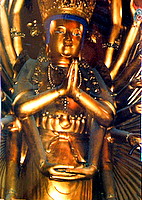 A thousand arms
One of the most fascinating aspects of Quan Yin is her ability to appear in countless forms. According to Chapter 25 of the lotus sutra—sometimes called the “Universal Gateway” chapter—she manifests in whatever form best serves those who call upon her.
The Thirty-Three Manifestations
Buddhist teachings describe how this compassionate bodhisattva can appear in different forms to best deliver guidance and aid to those in need. The following are some examples of the thirty-three manifestations of Guan Yin:
- A wandering monk or a Buddhist nun
- A young man or a young woman
- A child
- A king or government official
- A dragon or deity
- Even non-human forms, when necessary
- As Jesus Christ or Virgin Mary, to reach those from other religious traditions.
This flexibility isn't arbitrary—it reflects the Mahayana principle that enlightened beings employ skillful means to reach different people. A fisherman might encounter her as a village woman, while a scholar might meet her as a learned monk.
Quan Yin Transformation
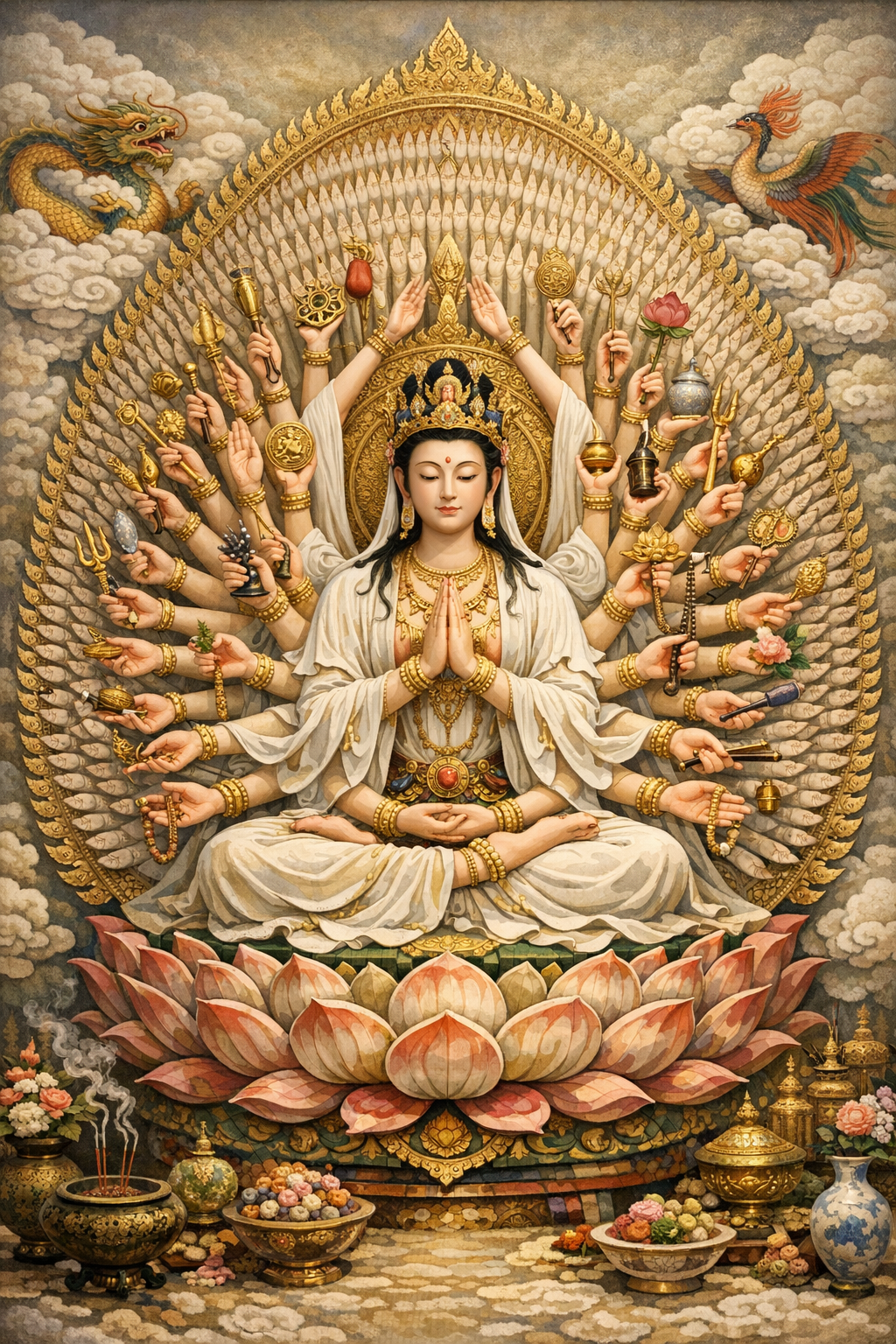 A Thousand arms
Legend states that Guan Yin, after hearing the cries of world, refused to enter nirvana and vowed to stay within the earth realm to assist and bring salvation to the whole world.
However, she realized that the number of suffering beings was massive and boundless. Despite her strenuous effort, the mission of relieving suffering was overwhelming.
Finding herself unable to fulfill the numerous demands, her head split into eleven pieces.
Daniela Schenker states that Amitabha, the spiritual father of Avalokitesvara/Guan Yin, "swiftly comes to the aid...transforms each fragment into an entire head...twenty-two eyes with which to identify suffering and eleven brains to find the best remedy to liberate all beings!"
With twenty-two eyes and eleven heads, she continued her mission. However, she discovered that more was needed. In her continuous endeavor to ameliorate humanity's suffering, Avalokitesvara/Quan Yin's two arms shattered into pieces. Once again, Amitabha Buddha aided her, granting her a thousand arms to better assist the needy.
Another compelling legend is the story of Miao Shan- the embodiment of Quan Yin.
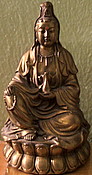 |
Quan Yin Statue
Miao Shan
The most beloved folk legend links Quan Yin to Princess Miao Shan, a tale dated to around 700 BC but researched and recorded by Buddhist monk Chiang Chih-ch’i in 1100 AD.
Miao Shan was the daughter of a wicked and greedy King. In an effort to expand his fortune, the King arranged a marriage alliance between Miao and a wealthy and powerful man. When he commanded her to marry the man, she agreed to obey only if the marriage eased three misfortunes- death, poverty and disease.
Angered by his daughter's demands and her refusal to marry, the King disowned her and sentenced her to live in a monastery as a Buddhist nun, where she had to do hard labor. She accepted her punishment without protest and performed her chores with love.
The King became frustrated and ordered his men to burn down the monastery with everyone inside. When Miao Shan realized that the monastery was on fire, Daniela Schenker writes, "...she pierced her tongue with a hairpin-soon blood began to shoot from it. This summoned heavy storm clouds, and it started to rain." Immediately, the fire ceased, and everyone was saved.
By now, the King was livid and wanted his daughter dead. He ordered her to be executed but to no avail. Every weapon used against her was useless. In Wikipedia, it states that the axe and sword used to carry out the task, "shattered into a thousand pieces."
Moreover, Daniela Schenker states, "Suddenly, the air became very still, and a huge white tiger appeared. He grasped Miao Shan and then bounded away with a single giant leap."
Additionally, the legend says that the supernatural tiger took her to hell, where she met the demon, Yama. There, she encountered suffering souls crying out for mercy. As she began to shower them with love and boundless compassion, the suffering souls began liberating themselves. The presence of Miao Shan in hell "turned it into a paradise."
Yama, recognizing that Miao Shan did not belong in hell, released her and gave her a, "peach of longevity as a gift."
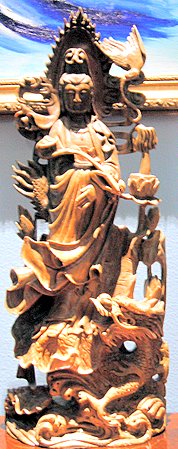
Upon returning to earth, Miao Shan went to Putuo Shan, an island located in the southeast of Shanghai, China. She remained there, "in deep meditation for many years."
While in deep meditation, Miao Shan had a vision in which her father was gravely ill.
Indeed, the King was extremely ill. A Monk informed the King that he could cure him, "by making a medicine out of the arm and eye of one without anger." Furthermore, he stated that such a person lived on the island of Putuo Shan.
The King ordered a messenger to go to Putuo Shan and retrieve the needed items. Upon the messenger's return, the medicine was prepared and administered, and the king recovered fully.
In gratitude for the service the compassionate and unselfish being had given him, the King decided to visit the cave where the divine being lived.
Daniela Schenker writes that when the King and Queen entered the cave, "they discovered that this miraculous being was their daughter, Miao Shan. The cave was bathed in brilliant light as Miao Shan transformed into her sacred manifestation with a thousand eyes and arms and floated away."
In gratitude and reverence, the King built a shrine where he was reunited with his daughter- now called Fragrant Mountain.
Guan Yin's Transformation
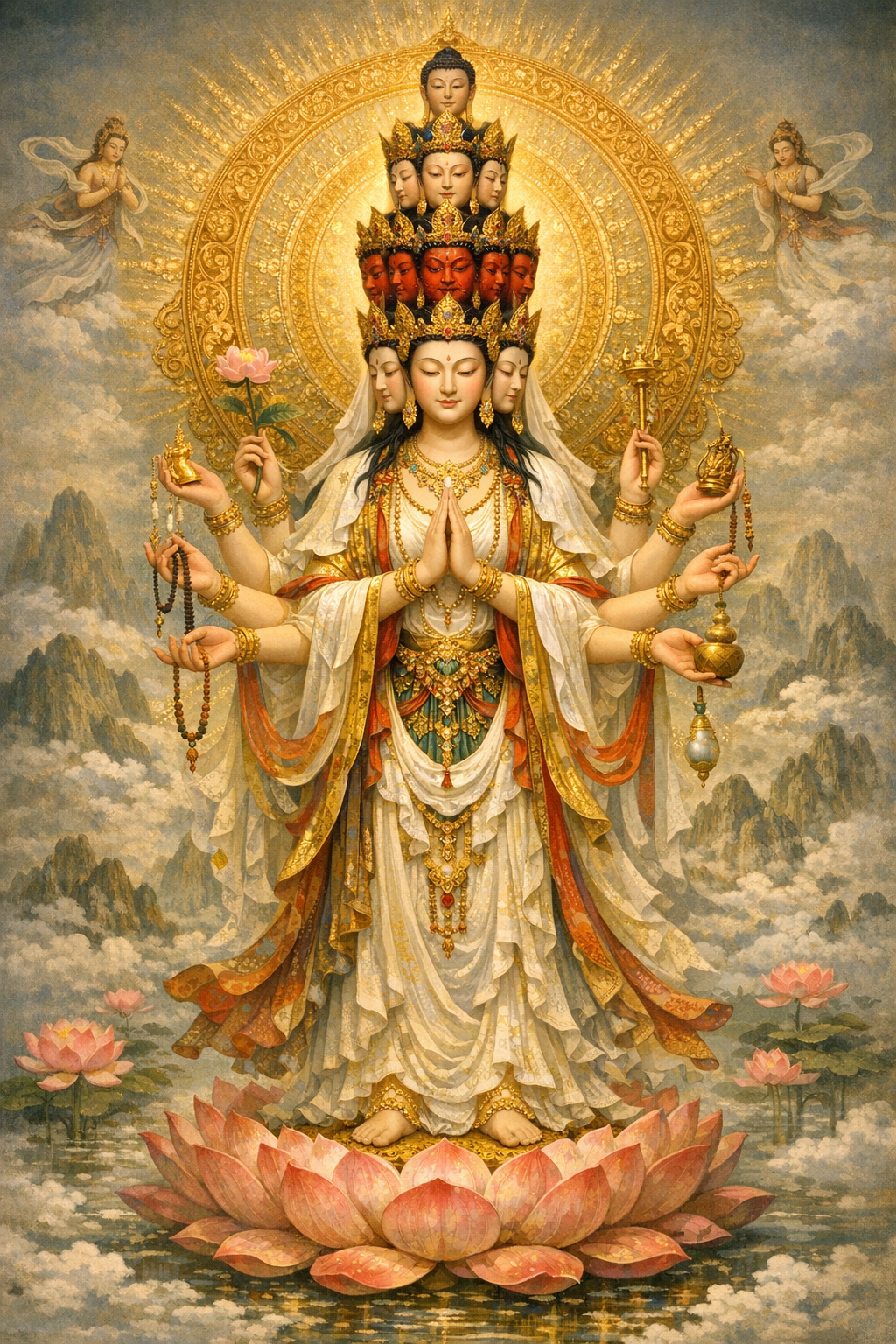 Goddess of Mercy - one of the San Ta Shih (one of the three powerful ones)
Perhaps no image of Quan Yin is more striking than her esoteric form with eleven heads and a thousand arms.
The legend explains: Guanyin vowed never to rest until all sentient beings achieved liberation. As she worked tirelessly, the cries of suffering became overwhelming. Her head split into a thousand pieces from the weight of the world's pain.
Amitabha Buddha, moved by her devotion, reformed her shattered being into a bodhisattva with:
- Eleven separate heads to hear all pleas simultaneously
- A thousand arms to reach everyone who calls
- Eyes on each palm for all-seeing compassion
This form appears throughout Buddhist temples in both China and Japan, representing what happens when compassion meets infinite capacity to help.
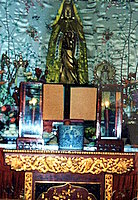 |
| Ceremonial Altar |
Guan Yin- Protector and Healer of Women
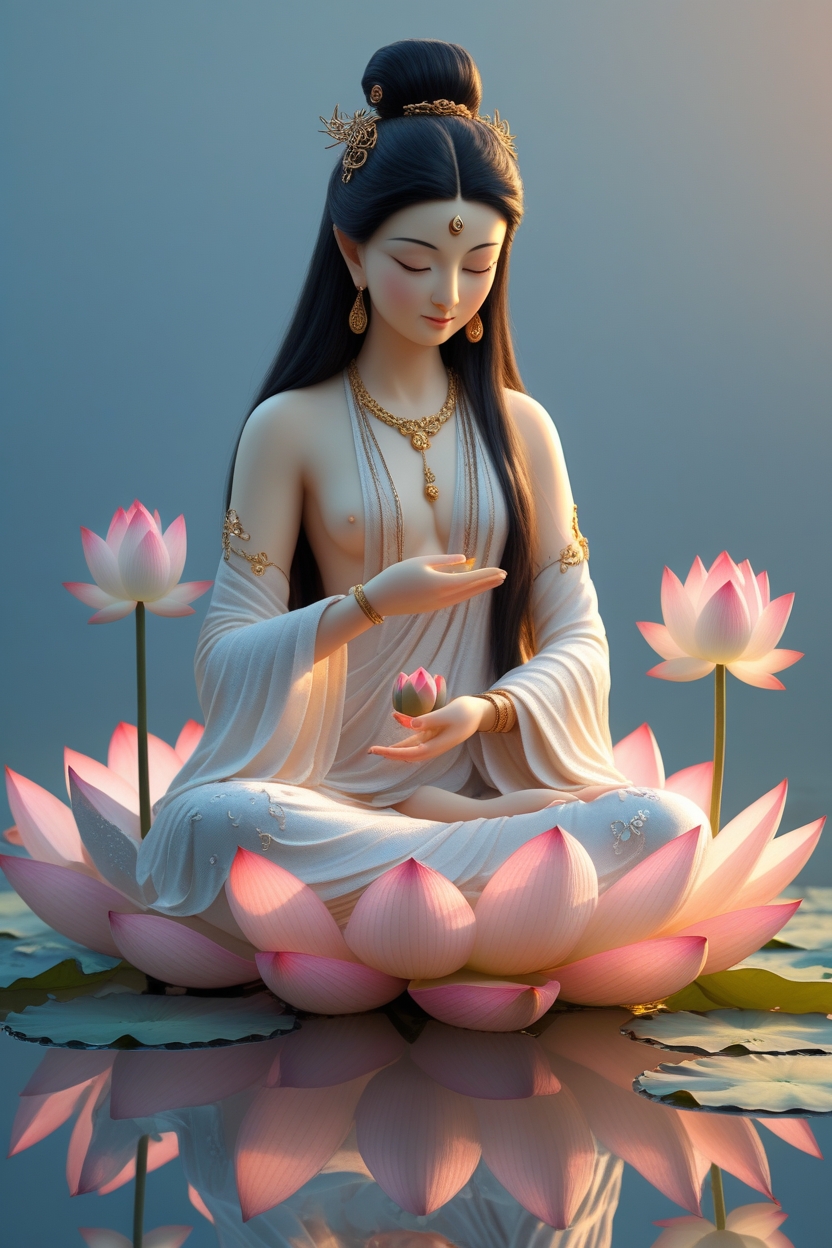 Guan Yin - the Goddess of Mercy and Lotus Flower
Guan Yin is the protector of all women. She hears the cries of women around the globe.
Many pregnant as well as childless women are her faithful followers.
Many see her as the patron saint of mothers and the needy.
Story of a Guan Yin Devotee
A woman once told me an interesting story about Guan Yin, the Goddess of Mercy. This woman had been married for several years without conceiving. The couple's greatest desire was to have a child.
She had gotten pregnant a few times, but only to have a miscarriage in her first trimester.
After numerous miscarriages, she felt defeated and hopeless. Her dreams of becoming a mother were unlikely.
One day, she met a woman who transformed her life.
During a conversation, the woman said she noticed a deep sadness in her eyes. Instead of confirming the woman's observation, she told her she was fine.
When the woman asked whether she had any children, she could not conceal her true feelings. When she said she had none, a tear rolled down her face.
The woman told her to pray to Guan Yin, the Goddess of Compassion. She added that Guan Yin was the Fertility Goddess, very merciful, and had helped many childless women.
Although she was aware of Guan Yin, she never thought of praying to her.
She began praying to Guan Yin and soon became pregnant. Afraid of having a miscarriage, she prayed faithfully every day.
Nine months later, she and her husband became the proud parents of a baby boy.
After twenty-odd years, she and her husband remain faithful devotees to Mother Quan Yin, the Goodess of Mercy.
Guan Yin Fertility Prayer
Great Bodhisattva, Blessed Mother Guan Yin, Goddess of Mercy, I pray ye, help me to be fertile, I pray ye, help me to be fruitful, I pray ye, help me to conceive a healthy child, I ask this with all of my heart, I ask this with my body and soul, I ask this in your holy name, So be it! Blessed Be! Amen! (taken from a prayer book)
My Journey to China
During a trip to China, I attended a religious ceremony dedicated to the deceased parents of my friend. The ceremony was conducted in a Buddhist temple in Shanghai. The ceremony was beautiful and captivating.
The temple consisted of numerous rooms of worship. In the courtyard was an enclosed area devoted to the Guan Yin Goddess. Upon entering, I was welcomed by two colossal statues of Guan Yin in all her glory. The presence of the two statues, One Thousand Arms Quan Yin and Quan Yin, covered in a silk robe, was transcendent. The Guan Yin Goddess was spectacular.
 | |
Guan Yin Prayers
PRAYER
May the peace of God be upon this household! May the love of God be in your hearts! May the light of God be in your souls! May the wisdom of God be in your mind! May the virtue and purity of God be in your feelings! May the strength and vitality of God be among the members of your household! May the health and well-being of God be manifest through the bodies, the garments that you wear! May the grace of God be in your action! May the talents and genius of God be manifest through your senses! May the fullness of the victory of your own God's plan be manifest through your souls at the close of your earthly life!
Call unto me and I will answer thee!
Author unknown.
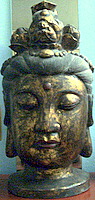 |
Prayer
Divine Guan Yin, Goddess of Mercy, hear my prayer. On this day, GIVE me the strength and health to continue my mission on the earth plane. TEACH me to be compassionate to others without wanting anything in return. PROTECT me from all those who wish to do me harm. HELP me to reach the right path to enlightenment. FILL me with your divine energy now and always...Composed by me.
For all individuals who claim that they don't know how to pray, I simply say- if I can do it, so can you. Remember, prayer comes from the heart. All you need to do is express what you feel. Guan Yin is always listening to those who pray to her. Start by introducing yourself, and the rest will follow.
I hope that you have enjoyed the various pictures of the Divine Guan Yin Goddess. If you have a story that involves Divine Guan Yin and would like to share, please do so by clicking on the Contact Us button.
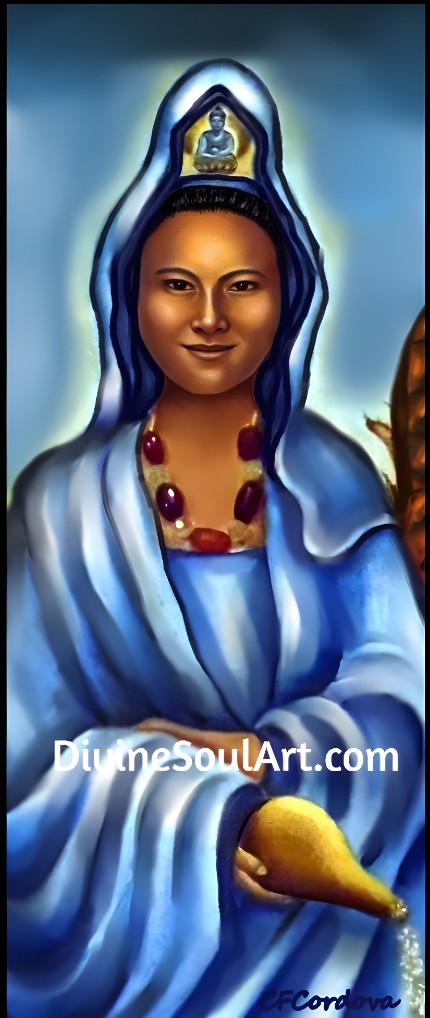 Guan Yin - Goddess of Mercy
GO BACK TO
Click below and view more than 600 pieces of spiritual artwork

Spiritual Books
If you enjoy the articles on this website, you will also appreciate the short stories in the books below. Click here and continue the journey.