What is Santa Muerte?
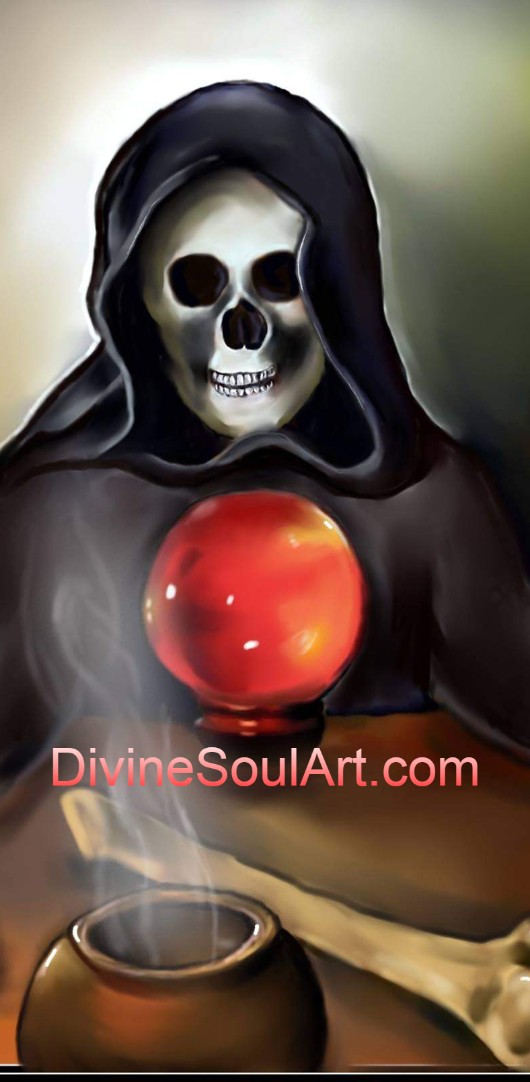 La Santa Muerte - Holy Death
On this page:
What Is Santa Muerte?
What is Santa Muerte?
Santa Muerte, also known as Holy Death, Saint Death, or La Señora de las Sombras (The Lady of the Shadows), is a Mexican folk saint who personifies death as a robed female skeleton often holding a scythe and globe. She is venerated by millions of devotees, especially in Mexico and among Latino communities in the United States and Latin America.
Similar to the Hindu Goddess, Kali, Santa Muerte is both widely venerated and widely misunderstood. To some, she is a dangerous or forbidden figure. To others, she is a powerful protector who offers help without judgment. Understanding Santa Muerte requires looking beyond sensational headlines and examining her history, symbolism, and role in everyday devotional life.
Unlike canonized Catholic saints, Santa Muerte was never a historical person officially recognized by the Catholic Church. Instead, she emerged through a blend of Indigenous death beliefs, popular folk religion, and Catholic symbolism. For many followers, she is a powerful spiritual protector associated with healing, justice, protection, safe passage through danger, and guiding loved ones into the afterlife.
Santa Muerte remains controversial. The Roman Catholic Church rejects devotion to her, while devotees often see her as compassionate, impartial, and especially close to people who feel excluded, vulnerable, or forgotten. To understand why she inspires both devotion and criticism, it helps to look at her origins, symbols, rituals, and place in modern spiritual life.
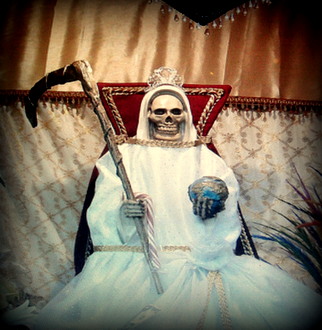 La Santa Muerte - Folk Saint
Origins and History of La Santa Muerte
Santa Muerte's origins stem from a complex blend of pre-Hispanic death beliefs and Catholic Church traditions brought by Spanish colonizers in the 16th century. Understanding her history involves tracing connections from ancient Mesoamerican spirituality through centuries of religious blending during colonial times.
Many scholars draw a conceptual link between Santa Muerte and Mictecacihuatl, the Aztec goddess who ruled the underworld (Mictlān) alongside her husband Mictlantecuhtli. Mictecacihuatl—often called the “Lady of the Dead”—presided over the bones of the deceased and was honored during festivals that eventually merged with Catholic observances like All Saints' Day and All Souls’Day, giving rise to Mexico's famous Day of the Dead celebrations.
When Spain conquered Mexico, missionaries sought to suppress Indigenous practices they considered pagan or demonic. However, death worship and ancestor veneration didn't disappear—they went underground. Over centuries, these beliefs blended with Catholic imagery: skeletal figures wearing nuns' habits and prayers structured like Catholic novenas. The familiar yet unsanctioned skeleton saint emerged from this cultural mixing.
Early scattered references to a “Santa Muerte” figure appear in colonial records and 9th-century folk practices, but devotion remained largely private, secretive, and family-based for centuries. Devotees kept her images hidden in home altars, avoiding public display.
The key turning point came around 2001. That year, Enriqueta Romero—known affectionately as Doña Queta—placed a life-sized statue of Santa Muerte (Saint Death) on her front porch at Alfarería Street #12 in Tepito, one of Mexico City's poorest and most dangerous neighborhoods. This simple act of making private devotion public sparked a revolution. Monthly rosaries began drawing thousands of attendees. News coverage spread. What had been a hidden folk practice transformed into a visible, fast-growing religious movement.
From the early 2000s onward, Santa Muerte evolved from a local curiosity into a transnational phenomenon spanning Mexico, Central America, and migrant communities throughout the United States. Scholars like R. Andrew Chesnut of Virginia Commonwealth University have called her “the fastest-growing new religious movement in the Americas.”
Symbols and Iconography of Santa Muerte
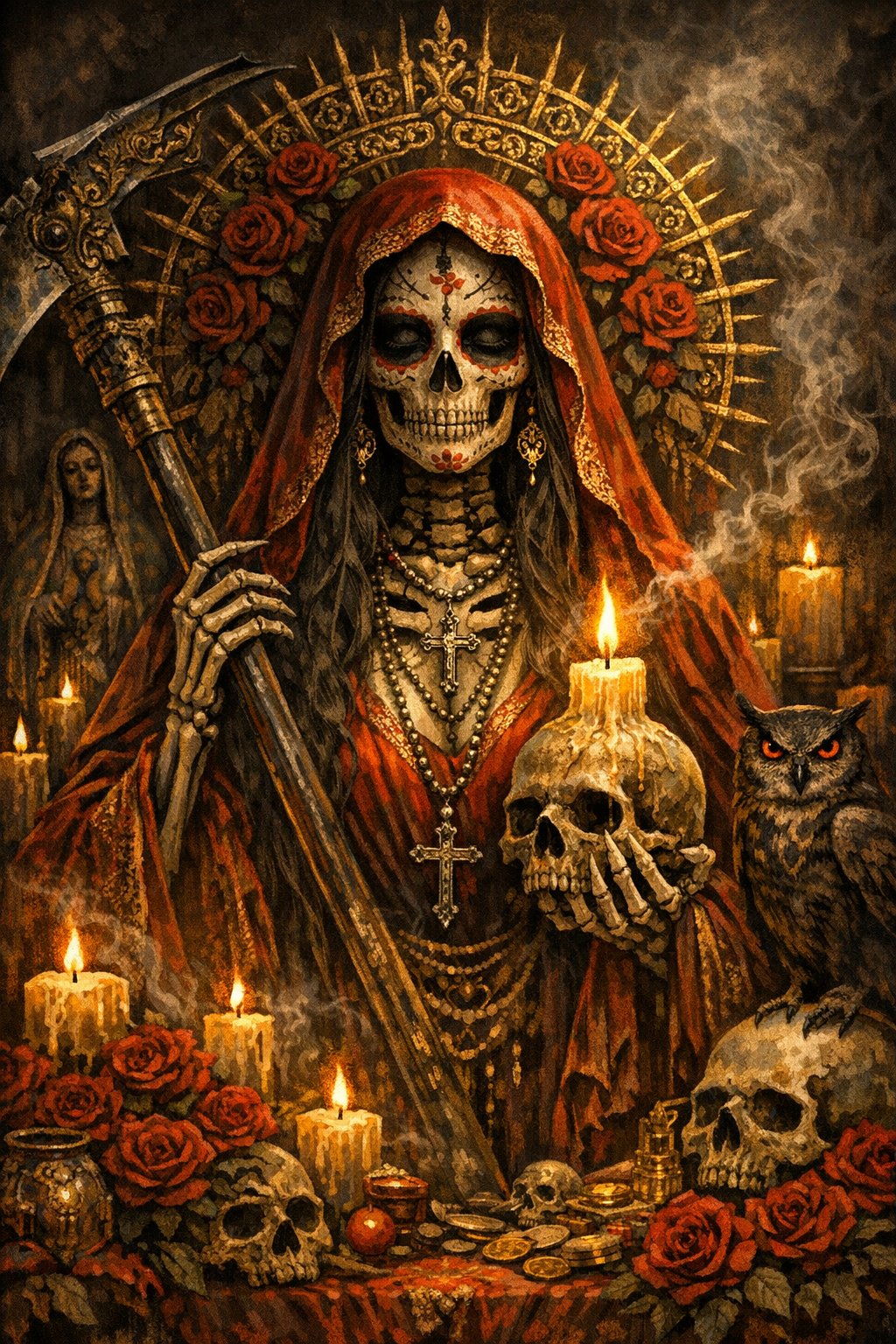 La Santa Muerte or Saint Death - Folk Saint
Santa Muerte's visual symbols communicate her powers and help devotees direct their petitions toward specific needs. Each element of her iconography carries meaning.
Her core image is a full-length female skeleton wearing flowing robes—often reminiscent of the Virgin Mary's garments or a nun's habit. Despite being skeletal, she is distinctly feminine (reflected in the Spanish grammar: Santa rather than Santo). Many representations show her with long hair or a veil, emphasizing her gendered identity. This powerful lady commands respect while inviting intimacy.
The objects Santa Muerte holds reveal her domains of influence:
1-Scythe -Power over life and death; cutting through obstacles; protection.
2-Globe -Dominion over the world and human fate.
3 -Scales- Justice and balance.
4 -Hourglass-Time, patience, mortality's inevitability
5 -Owl- Wisdom, night vision, guidance through darkness.
6 -Lamp- Illumination, safe passage, clarity.
Colors:
Color symbolism plays a vital role in Santa Muerte worship. The colors of her robes and the candles lit before her statue indicate the specific favor being asked for. This system allows followers to customize their practice and express particular intentions.
Many devotees maintain her statue or image on a dedicated home altar, often positioned separately from other saints. This separation reflects both respect for her unique power and a desire to avoid spiritual “conflicts” with mainstream Catholic figures. The altar becomes a focal point for daily interaction with the skeleton saint.
Santa Muerte Candle Colors and Meanings
Candle color forms the heart of Santa Muerte practice, functioning as a visual language between devotee and saint. When someone lights a candle before her image, the color communicates what they need.
The most common colors and their intentions include:
- White – Purification, general blessings, spiritual cleansing, protection for children
- Red – Love, passion, romantic relationships, sexual attraction
- Black – Protection from enemies, reversal of harmful energy, defense against crime
- Gold/Yellow – Money, business success, prosperity, finding employment
- Green – Justice, legal matters, healing, help with court cases or immigration issues
- Blue – Wisdom, calm, spiritual growth, peace in the household
- Purple – Transformation, deep healing, breaking addictions, spiritual power
Devotees often burn multiple colored candles simultaneously when facing complex situations. For instance, someone dealing with both a court case and financial hardship might light green and gold candles together. Commercial “seven-color” Santa Muerte votive candles—incorporating all major intentions in rainbow bands—are sold throughout Mexico and in Latino neighborhoods across U.S. cities, particularly in botanicas (spiritual supply shops).
These meanings can vary between regions and individual practitioners, reinforcing the folk, decentralized nature of the devotion. There is no central authority dictating correct practice.
Santa Muerte Rituals, Altars, and Everyday Devotion
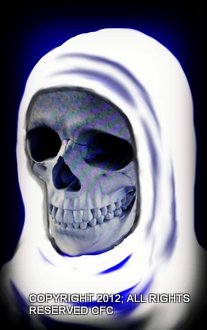 santa muerte - folk saint
Santa Muerte worship is mainly informal and practiced at home. Unlike organized religions with official clergy and fixed rituals, most devotion happens at personal altars kept in bedrooms, living rooms, or small shops.
A typical altar includes:
- A statue or printed image of Santa Muerte
- Candles in colors matching current petitions
- Fresh flowers (especially marigolds and roses)
- Glasses of water or tequila/mezcal
- Food offerings (fruit, sweets, mole, bread)
- Cigarettes or tobacco
- Coins and small bills
- Personal items belonging to the devotee or someone being prayed for
- Notes of petition or gratitude
Types of Petitions and Promises
The relationship between devotee and Santa Muerte often follows a reciprocal logic: I give so that you give. This exchange underlies much of the practice.
The most common requests include:
- Physical safety in dangerous neighborhoods or high-risk occupations
- Help finding or keeping employment
- Success in small business ventures
- Healing from illness, injury, or addiction
- Romantic help—attracting love, keeping a partner faithful, or ending a bad relationship
- Assistance with court cases, immigration matters, or debts
- Protection for loved ones, especially children or incarcerated family members
Devotees frequently make formal promises (promesas) in exchange for granted favors. These might include walking in a public procession, wearing a Santa Muerte necklace for a set period, donating to a public shrine, or placing a gratitude offering on the altar. Many followers see Santa Muerte as fundamentally non-judgmental—willing to listen to anyone regardless of their past, their occupation, or whether the Catholic Church considers them worthy. The only unforgivable offense is ingratitude: breaking promises or failing to acknowledge favors received.
Where Santa Muerte Is Worshipped
Santa Muerte in Mexico and Latin America
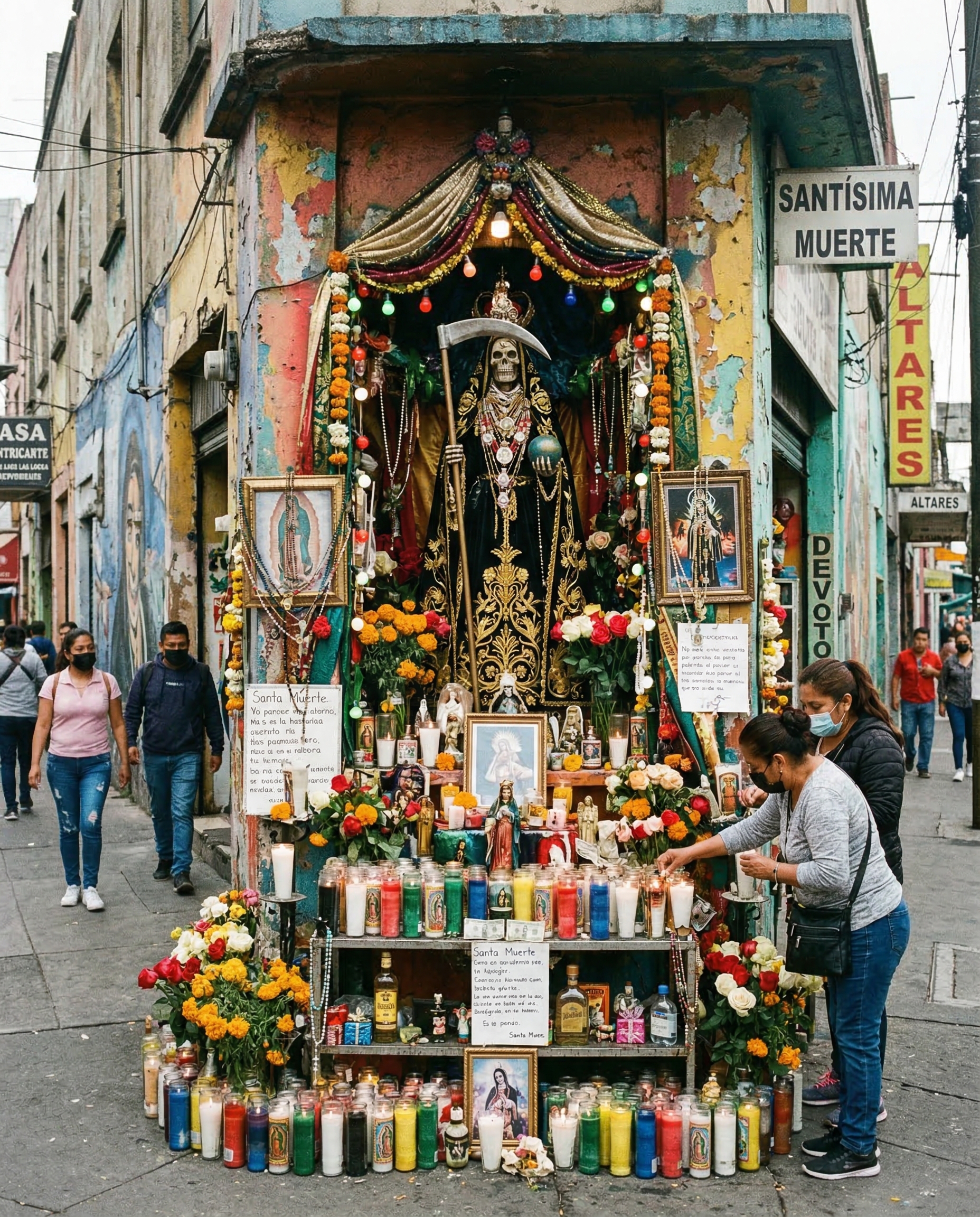 Santa Muerte Shrine and Santa Muerte's Origins - Mexico City
While Santa Muerte has spread internationally, Mexico remains her heartland. Estimates suggest roughly 70% of the world's 10-12 million devotees live in Mexico, with particularly strong followings in urban areas marked by poverty, violence, and precarious employment.
Mexico City stands as the primary center, especially the Tepito neighborhood where Doña Queta's street shrine transformed private folk practice into a public movement. By the mid-2000s, researchers had documented approximately 250 visible altars and shrines in Mexico City alone. Monthly gatherings draw thousands, and the annual November 1 celebration has become a major event covered by national and international media.
Santa Muerte devotion intersects naturally with broader Mexican death culture. Dead celebrations like Día de Muertos, sugar skull imagery, cemeteries filled with flowers and candles, and a familiar (sometimes humorous) approach to mortality all create cultural space for a skeleton saint. Death is not hidden in Mexico—it is acknowledged, decorated, and occasionally mocked.
Her following spans social classes but remains particularly strong among:
- The urban poor and informal workers
- Street vendors, taxi drivers, and bus operators
- People living in high-crime areas who feel unprotected by the state
- Prisoners and their families
- Those working in Mexico's vast informal economy
In Central America—particularly Guatemala, Honduras, and El Salvador—devotees often invoke Santa Muerte for protection amid gang violence, forced displacement, dangerous migration routes, and extortion. Prayers and rituals adapt to local realities while maintaining the core symbolism.
Santa Muerte's visibility has grown throughout Latin America via media coverage, popular music (especially narcocorridos), tattoos, and merchandise such as prayer cards and statues sold in markets. She has become a recognizable figure far beyond devotee communities.
Devotees and Social Groups
Santa Muerte attracts a remarkably diverse base. Her followers include housewives seeking family protection, shopkeepers praying for business success, migrants asking for safe border crossings, and prisoners hoping for early release or protection behind bars.
Her special importance to marginalized groups stands out. LGBTQ+ communities, sex workers, undocumented migrants, and others stigmatized by mainstream society find in her “the saint who asks no questions.” Unlike the Catholic Church confession, which requires acknowledgment of sin, Santa Muerte devotion makes no moral demands beyond fulfilling promises. The bony lady welcomes everyone.
This non-judgmental stance cuts across institutional lines. Some police officers, soldiers, and security guards also venerate her—asking protection in contexts of extreme violence. Criminal involvement with Santa Muerte grabs headlines, but teachers, nurses, office workers, and retirees also maintain her altars. The cult spans moral and social categories that might seem contradictory.
Santa Muerte in the United States
Santa Muerte devotion began appearing publicly in the United States in the early 2000s, carried primarily by Mexican and Central American migrants seeking spiritual protection in their new and often precarious circumstances.
Key urban centers where her presence is most visible include:
- Los Angeles – Large Mexican-American population, numerous botanicas
- Houston – Major migration hub with strong connections to northern Mexico
- Chicago – Established Mexican neighborhoods on the south and west sides
- New York City – Diverse Latino communities throughout the boroughs
- Border cities (El Paso, San Diego, Tucson) – Close cultural ties to Mexico
In these cities, botanicas sell Santa Muerte candles, statues, oils, and prayer cards alongside supplies for other folk traditions. U.S. altars often blend Mexican practices with local influences, sometimes sharing space with images of Catholic saints, Afro-Caribbean spirits like those from Santería, or other folk practices. This mixing reflects the religious creativity of immigrant communities.
Media attention in the United States has tended to focus on dramatic or criminal cases—cartel connections, crime scene altars, sensational rituals. This coverage has shaped a sinister public image. But the vast majority of U.S. devotees are regular workers, families, and small business owners seeking protection and prosperity in difficult circumstances. They light candles for sick relatives, pray for help with immigration paperwork, and ask for safety in dangerous jobs.
Religious responses in the U.S. vary. Some Catholic leaders have explicitly warned against Santa Muerte as incompatible with church teaching. The Catholic News Agency has published statements from bishops calling her veneration spiritually dangerous. Other clergy adopt a quieter, pastoral approach toward devotees, recognizing that harsh condemnation rarely changes hearts.
For migrants navigating dangerous journeys, precarious jobs, and legal uncertainty, Santa Muerte has become a transnational symbol of protection. She travels with them—in wallet-sized prayer cards, small medallions, and smartphone wallpapers.
Controversies and Catholic Opposition
Media Coverage, Crime Associations, and Misconceptions
Santa Muerte is one of the most controversial folk religious figures in the Americas. Much of this controversy comes from her association, in media reports, with organized crime, violence, and sensational ritual stories. Because some criminals have kept Santa Muerte altars or carried her images, public coverage has often portrayed her as a “narco-saint."
Some time ago, Santa Muerte drew attention. Several news reports appeared on television. Reports of extreme ritual abuse and alleged human sacrifice occasionally appeared in the news.
1-A Mexican family murdered three acquaintances and offered their blood to Holy Death in exchange for blessings in health and wealth.
2-A mother plucked the eyes of her child with a spoon during a Santa Muerte ceremony. When questioned, she responded that the child would not close his eyes.
3-In March 2012, eight people were arrested in Mexico for murdering a woman and two boys while performing a human sacrifice in the name of Santa Muerte.
Are human sacrifices a part of Santa Muerte rituals, or are the above-mentioned isolated cases of violent acts committed by demented and fanatical devotees who devise their own set of rules to satisfy their inner diabolical hunger?
Scholars, religious researchers studying the movement, and many devotees stress that these cases represent only a small portion of a much larger devotional community. Furthermore, Saint Death does not demand human sacrifice; these acts are condemned as abominations and a violation of their sacred beliefs.
Most followers are not involved in crime. They are ordinary people who pray for protection, healing, justice, work, and stability in difficult circumstances.
R. Anderson Chesnut, author of Santa Muerte: The Skeleton Saint's Deadly American Debut, states, “… most devotees, echoing the statements made by unofficial cult leaders, reject human sacrifice as a satanic aberration of ritual veneration of the Mexican folk saint. Sacrificial offerings such as candles, flowers, water, food, tobacco, and prayers are a routine part of the devotion. As a parched skeleton, Santa Muerte is particularly fond of liquid offerings, such as water and tequila, but definitely not human blood.”
According to the research literature on Santa Muerte, most of her devotees, "... do not consider her to be satanic or view themselves as devil-worshippers." Many believe that she is "...a fallen angel in purgatory trying to win back God's favor, and that is the reason she grants so many miracles. Other devotees consider Santa Muerte to be an eighth archangel.”
Controversies and Catholic Opposition
Religious opposition has been consistent and forceful. Mexican Catholic Church bishops have repeatedly condemned Santa Muerte worship. In 2013, Vatican official Cardinal Gianfranco Ravasi called the cult “sinister and infernal.” During his 2016 visit to Mexico, Pope Francis criticized Santa Muerte as part of narco-culture, warning against “false idols.” Protestant churches in Mexico and Central America have similarly denounced her.
Catholic Church leaders offer several theological arguments against Santa Muerte:
- Death is a condition, not a person to worship. Unlike saints who were living humans modeling virtue, Santa Muerte represents an abstract concept dressed in religious imagery.
- Canonization requires miracles and moral example. The church has established procedures for recognizing saints; Santa Muerte meets none of these criteria.
- Rituals blur into magic. The transactional “I give so you give” relationship resembles barter with spiritual forces rather than humble prayer to God through Jesus Christ.
- She is not recognized. The Vatican and Mexican bishops have officially stated that Santa Muerte is not a Catholic saint and that devotion to her is incompatible with Christian beliefs.
Despite this official position, many lay Catholics quietly integrate Santa Muerte into their personal belief systems. They may see her as a servant of God, an unofficial intercessor, or simply a powerful spiritual ally. This gap between official teaching and popular belief reflects the complex reality of Mexican folk Catholicism, where indigenous practices, folk saints, and mainstream religion have mixed for centuries.
Despite this opposition, devotion continues to grow among followers who view her as compassionate, powerful, and accessible.
Furthermore, scholars emphasize important context. While some criminals do venerate Santa Muerte, they constitute a small subset of a much wider, mostly non-violent devotional community. Criminals also light candles to mainstream saints like the Virgin of Guadalupe or Jesús Malverde—yet those figures don't receive the same stigma. The skeleton saint's appearance makes her an easy target for sensationalism.
NOTE:
Let's take a moment to reconsider our judgments about Santa Muerte and whether we should label her as evil.
I recall meeting a woman who practiced something rather unsettling. Every Monday, she would devote time to praying to Saint Michael, the archangel known as a protector and warrior against evil. In her rituals, she would carefully light a candle and then turn the statue of Saint Michael upside down. In doing so, she would demand that he bring misfortune and harm to those she considered her enemies.
When I learned about her peculiar way of invoking the saint's power, I felt compelled to intervene. I explained to her that what she was doing was fundamentally wrong, emphasizing that Saint Michael is a high-level spiritual being who embodies goodness and justice. Actions that summon harm go against his nature, and I warned her that seeking vengeance in this way would only bring negative consequences, or bad karma, into her life.
Unfortunately, my words did not resonate with her, and she chose not to speak to me again after that conversation.
This experience taught me an important lesson: while individuals may pray to saints for ill intentions, the responsibility for such negative desires lies squarely with the person. It is not the saints who are at fault; rather, it is the darkness and malice that exist within people's hearts that lead them to seek harm against others. And, in many cases, mental illness.
Belief and Meaning Today
No single “church of Santa Muerte” has a unified doctrine, hierarchy, or catechism. Devotees' beliefs are diverse, personal, and often contradictory. However, several recurring themes shape this religious movement.Despite the absence of a formal or organized church dedicated to Santa Muerte, many practitioners within this spiritual tradition identify themselves as Santa Muerte priests. These individuals often perform rituals, prayers, and offerings to honor Santa Muerte, whom her followers view as a powerful figure representing death and protection. This self-identification as priests reflects the deeply personal and individualized nature of their beliefs and practices, which often take place outside of structured religious institutions.
Many devotees view Santa Muerte as an impartial, non-judgmental force. Death comes for everyone—rich or poor, guilty or innocent, young or old. This makes her justice fundamentally egalitarian. Unlike other saints associated with particular virtues or social groups, Santa Muerte plays no favorites. Her scales balance equally.
Ethics in Santa Muerte practice centers on interchange. She may grant favors to anyone—but she demands that promises be kept. Ingratitude and broken vows are believed to bring consequences. This reinforces personal responsibility: devotees must follow through on commitments made in desperate moments.
For many, Santa Muerte functions as an empowering guardian. Women in abusive relationships may pray for protection or strength to leave. LGBTQ+ persons rejected by family or church find unconditional acceptance. Workers in dangerous informal economies (construction, street vending, transportation) ask for safety that the state cannot provide. Migrants crossing dangerous borders carry her image as spiritual protection when human help is unavailable.
Ultimately, devotion to Santa Muerte encourages people to confront mortality openly. Instead of avoiding death or seeing it only as fearsome, followers combine an awareness of life's limits with a desire for protection, dignity, and control. In unstable lives, this direct connection with the powerful lady provides something mainstream religion often cannot offer: unconditional presence in the face of real danger.
Santa Muerte and Neo-Pagan / Esoteric Currents
Outside Latin America, some practitioners approach Santa Muerte through Neo-Pagan, occult, or ceremonial magic frameworks. These practitioners—often in the United States or Europe—combine her with tarot, astrology, witchcraft traditions, or other esoteric systems.
English-language spell books and manuals have emerged since the 2000s, systematizing prayers, spells, and candle rituals for audiences who may not be Catholic or even Christian. Books published by presses like Oxford University Press have also provided academic analysis, lending scholarly credibility to the topic.
This esoteric appropriation is sometimes criticized by Mexican devotees who see Santa Muerte primarily as a folk Catholic or culturally specific figure tied to Mexican identity, history, and struggle. For them, she is not a general-purpose magical tool but a living saint embedded in particular communities. The debate over who can legitimately work with Santa Muerte—and how—continues in online forums and devotional communities.
Miracle Story
During a chat with a friend, she shared an interesting story. Recently, while watching a TV program about religions and beliefs from around the world, she was drawn into a remarkable tale. It was the story of a young Mexican man who was saved from death.
While swimming in deep waters, the young man lost control. As he struggled to stay afloat, his efforts were useless. The current kept pulling him down. The force of the water was stronger than his fight to survive. He remembered losing his mobility and sinking. Suddenly, a skeletal figure dressed in a long white robe appeared, drifting in front of him. The figure grabbed him and gave him a small vial of liquid to drink. The last thing he remembered was waking up on a quiet, isolated beach, safe and sound.
Although the Church has condemned her as an evil entity, how can the Lady of Death be satanic when many believe she is “a fallen angel in purgatory trying to win back God's favor,” and that is why she grants so many miracles?
Additionally, would an evil entity save an individual from an unpleasant death, such as drowning?
Prayers to Santa Muerte
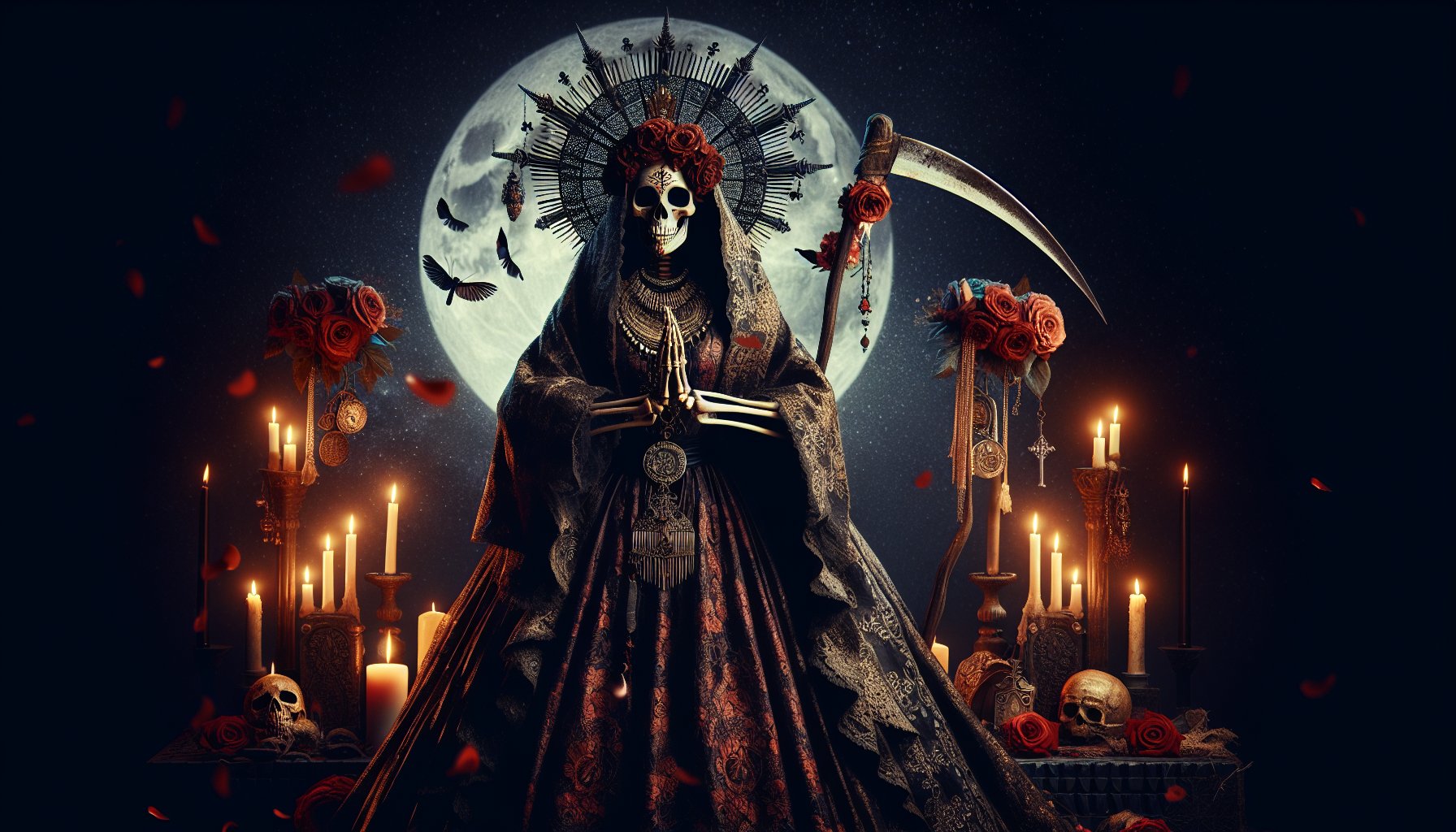 Santa Muerte, or Saint Death - patron saint of the rejected, unprotected, homeless, etc.
1-PROTECTION
Oh Santa Muerte, beloved lady of silence, you know the darkness of my heart and accept me.
Oh, sweet accomplice and protector of lost souls, shield me from my enemies; season my life with sweetness.
You, who have dominion over all living things, do not forsake me!
In the temple of your arms, I will lie down.
Oh, desired death of my heart, I place my faith in thee.
(www.theinfinitynetwork.org/prayer-to-la-santa-muerte.html)
2-HEALING
"Santísima Muerte, at your feet I prostrate myself and earnestly ask you to give me health. Take away any disease so that I may move on. I ask you with all my heart to bless my body and soul, to banish all sickness and pain, and to wrap me in your healing, protective cloak. Amen".
Frequently Asked Questions About Santa Muerte
Is Santa Muerte a Catholic saint?
No. Santa Muerte is not recognized as a Catholic saint by the Roman Catholic Church. She is considered a folk saint, and Catholic leaders have repeatedly said that devotion to her is incompatible with official Church teaching.
Why do people pray to Santa Muerte?
Devotees pray to Santa Muerte for protection, healing, justice, love, prosperity, and help during dangerous or uncertain times. Many followers believe she is impartial and listens to people regardless of their social status or past.
Is Santa Muerte evil?
Views differ widely. Critics often see her devotion as spiritually dangerous, while devotees see her as a protective and non-judgmental figure. Much of the controversy comes from media portrayals, religious opposition, and criminal associations involving a small minority of followers.
What does Santa Muerte look like?
Santa Muerte is usually shown as a female skeleton wearing a robe and carrying symbols such as a scythe, globe, scales, owl, or hourglass. These items represent death, justice, wisdom, time, and protection.
What do Santa Muerte candle colors mean?
Different candle colors are used for different intentions. White is often used for purification and blessings, red for love, black for protection, gold for prosperity, green for justice, blue for peace, and purple for transformation or healing.
Who worships Santa Muerte?
Her devotees come from many backgrounds, including workers, migrants, shopkeepers, prisoners, LGBTQ+ communities, and people seeking protection in difficult circumstances. Her following crosses social and economic lines.
Summary
The Church says that Santa Muerte is evil and satanic. Whether Santa Muerte is good or evil, you decide.
In my opinion, the people who committed the heinous crimes mentioned above are not Santa Muerte followers. They are mentally unstable individuals with criminal intent. For them, any image or religious symbol would suffice.
Monsignor William Lynn, a high-ranking priest dressed in traditional clerical attire and carrying a crucifix, was convicted of concealing child sex abuse. He was accused of allowing pedophile priests to remain in parish assignments. The prosecutor stated, “Lynn protected pedophile priests when he transferred them from parish to parish, where they victimized other children.”
Pedophile priests and those who protected them claimed to be followers of Jesus, not Santa Muerte. These individuals professed full devotion to Jesus' teachings. Did Jesus make them commit such horrific crimes against children? Of course not. These were men who harbored evil in their hearts while hiding within the sacred church of God.
Although they did not perform blood rituals, they practiced a form of human sacrifice. These so-called religious men committed the most hideous crimes by sexually abusing children.
Jesus, Santa Muerte, and any other religious icons are not responsible for the actions committed by sociopaths or evil doers. These individuals are inherently evil and destructive. While they may profess their faith, devotion, and love for a particular religion or image, it is only a facade. Their true goal is self-gratification at others' expense.
God has given us free will to make our own choices. We choose which path to take and must accept responsibility for our actions.
 Holy Death, or Santa Muerte is the patron saint of marginalized people
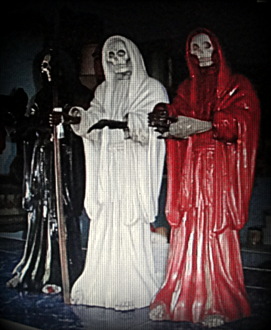 Holy Death or santa muerte's image
Related Links
1- Different Spiritual Beliefs
Click below and view more than 600 pieces of spiritual artwork

Spiritual Books
If you enjoy the articles on this website, you will also appreciate the short stories in the books below. Click here and continue the journey.